1. INTRODUCTION
The relationship between social mobility, economic performance, and inequality during processes of structural change is still far from established (Clark et al., 2015). The large number of dimensions through which social mobility might operate, along with the wide array of factors that come together when determining the social mobility of individuals in different contexts (Black et al., 2020; Bowles & Gintis, 2002; Mogstad & Torsvik, 2023), makes it challenging to draw definitive conclusions. Considering occupational categories can be useful to overcome these obstacles, not only because occupations are categories that are informative of an individual’s socioeconomic situation, but also because their explicitness allows to analyze them in a very direct way (Abbott, 2006). Perhaps unsurprisingly, occupations have been one of the preferred outcomes for economic historians to analyze social mobility. In fact, it has been argued that the analysis of occupational mobility has an interest per se, insofar as it allows for a better understanding of “the timing and dynamics of major economic processes” (Freschi & Martinez, 2024: 47).
In this regard, and beyond studies focused on specific countries1, literature has been able to prove the existence of differential global patterns in the historical evolution of occupational mobility. Specifically, there existed wide differences in the degree of intergenerational occupational mobility between countries at both sides of the Atlantic during the 19th century (Bourdieu et al., 2009; Long & Ferrie, 2013). Pérez (2019) has convincingly argued that the divergence in occupational mobility between Argentina and the United States can be attributed to differences in relative land abundance in the Americas with respect to Europe. In other words, easier access to land for independent agricultural workers in the Americas could be the main reason behind the divergence. This is a key finding since the issue of land abundance in the New World has further resonances in the literature: the reduction in transportation costs that took place throughout the 19th century allowed for Heckscher-Ohlin dynamics to come into play, with the progressive specialization of countries with greater relative land abundance in the production of commodities to be exported, leading to convergence in commodity prices and wage-rent ratios (O’Rourke & Williamson, 1994; Williamson, 2002), and potentially altering the inequality dynamics of the countries with relative abundance of specific factors of production. Indeed, it has been found that globalization had a profound impact on welfare and inequality in commodity exporting countries (Chilosi & Federico, 2024). If this is the case, then we must advance in our knowledge on the relationship between globalization and occupational mobility.
The aim of this paper is to contribute to a better understanding on the matter from the perspective of a country that became a world leader of agricultural exports: Spain in the market of Mediterranean horticultural products and, particularly, oranges (Pinilla & Ayuda, 2008, 2010). Specifically, I analyze the incidence of occupational mobility in a salient municipality of the Spanish intensive agriculture model by quantifying its magnitude and analyzing its main characteristics using individual-level data. As horticultural products were Spain’s main export, my analysis focuses on the occupational implications that the turn towards intensive agriculture and large-scale export had for the population on which such a model relied as labor force, with special emphasis on agrarian workers. I focus on the mobility of individuals through their life-cycle (intragenerational mobility) rather than through several generations of a lineage (intergenerational mobility), so as to obtain a more nuanced vision of occupational mobility by not assuming that the occupation of an individual remains stable over time (Kalleberg & Mouw, 2018). This brings me close to the approach that has tried to delve into the dynamics of occupational mobility in agriculture with special interest on the transition from laborers to owners (Alston & Ferrie, 2005; Alston & Kauffman, 1998; Atack, 1988, 1989), on the basis of the classic metaphor of the agricultural ladder (Lee, 1947; Spillman, 1919). In this regard, my interest focuses on absolute occupational mobility, understood as the capacity of structural change to facilitate upward mobility within the social strata most directly affected by the economic transformations that drove it, agrarian workers, precisely through the improvement of the conditions of access to land.
The analysis of the evolution of occupational mobility —whether across generations or during the life-cycle— in Spain from a historical perspective is a topic that has received increasing attention in the last years, although few studies have undertaken the task of analyzing historical occupational mobility in rural areas and, more specifically, in areas that specialized in export agriculture2. Focusing on the Valencian Country, Santiago-Caballero (2020) shows that intergenerational occupational mobility in the provinces of Valencia and Alicante was very low during the central decades of the 19th century. However, these results cannot be interpreted as being related to intensive agriculture because the analysis ends in 1870, a time when the transition to intensive agriculture had not been completed and citrus exports were still in their infancy, much less the effects they could have had on social mobility3. It is therefore necessary to gather further evidence by closely analyzing other spatial and temporal contexts linked to export agriculture that can shed light on the phenomenon. In this sense, in this paper I focus on occupational mobility in a very specific micro-context that is, however, highly representative of the Spanish model of export-oriented intensive agriculture. I do that through an historical source previously unused by the literature that provides individual-level data on occupation and other personal information for adult males. This allows me to tackle the research question using a complete-count census dataset, allowing me to link individuals from censuses in different years and, eventually, with censuses of other municipalities and other levels of territorial aggregation (Gutmann et al., 2018).
The case study of my choice is the city of Borriana, in the province of Castelló, one of the most salient centers of orange production and export during the first third of the 20th century in Eastern Spain. As I will show, the choice is far from arbitrary: Borriana was one of the Valencian municipalities where the transition towards orange cultivation occurred most intensely and from which a large amount of oranges was shipped abroad. The fact that European countries were the main export destination for Valencian oranges led to the construction of close and fluid communication channels between the city and the rest of the continent, giving the local population —until then eminently rural— a marked cosmopolitan character that transformed many of its social and economic structures (Abad, 2011). Building on the above, this paper seeks to explore whether occupational mobility existed within the Valencian model of intensive agriculture during its peak years. My results attest growing intragenerational social mobility during the period under study, both within and between agrarian and non-agrarian occupations. In addition, I provide evidence of the convergence in the position of farmers and laborers when acquiring land, revealing the existence of a process of facilitation of access to land towards the lowest layers of the productive system.
In this way, this article contributes to several strands of literature. Firstly, it takes the path indicated by Chilosi and Federico (2024) with respect to deepening our understanding of the effects of the First Globalization on inequality, with special emphasis on the regions that produced agricultural exports. However, unlike the literature that has dealt with these topics until now, this work does not study the case of a completely peripheral country but of the European semiperiphery (Wallerstein, 1985), with its differential traits in terms of response to globalization (Pamuk & Williamson, 2000; Tena-Junguito et al., 2024), especially with regard to its geographical position of greater proximity to higher-income countries and, therefore, lower transportation costs (Morilla Critz et al., 1999; Pinilla & Ayuda, 2006). Secondly, this work expands the available evidence on occupational mobility in contemporary Spain, putting on the table the case of an area that had not previously been considered by the literature and by presenting a hitherto unused historical source that may be very promising for future analyses of occupational mobility in Spain. If occupational mobility is considered to be another facet of living standards, then this work complements all the literature that has analyzed the evolution of the biological living standards of the Spanish population since the 19th century, especially in Mediterranean Spain (Galofré-Vilà et al., 2018; Puche-Gil, 2011). Finally, this contribution deepens into the renovation of traditional views on the supposed backwardness of the Valencian and Spanish agricultures and its complex internal dynamics, such as the nature of the relationship between landholders and tenants (Calatayud et al., 2006; Calatayud & Millán, 2010), the role of customary institutions in shaping the incentives of peasants and landowners beyond what market logic would predict (Garrido, 2013; Garrido & Calatayud, 2007, 2011) or the role of collective institutions in promoting economic dynamism without necessarily relegating the weak to a subordinate position (Garrido, 2011, 2012).
The paper is structured as follows. In Section 2, I provide the historical context on the Valencian model of intensive agriculture and exports and make the case that the city of Borriana is highly representative to be used as a case study for the analysis of the welfare implications of the intensive, export-oriented agriculture model. Section 3 describes the historical sources used, as well as the procedure followed to match individuals among the samples and the characteristics of the dataset derived. Section 4 analyzes the resulting transition matrices, estimates a set of econometric models to delve into dynamics of occupational mobility among the different occupational categories and discusses its results. Lastly, Section 5 briefly discusses the main results and points out further avenues for research on the matter.
2. HISTORICAL CONTEXT
2.1. The Valencian model of intensive agriculture
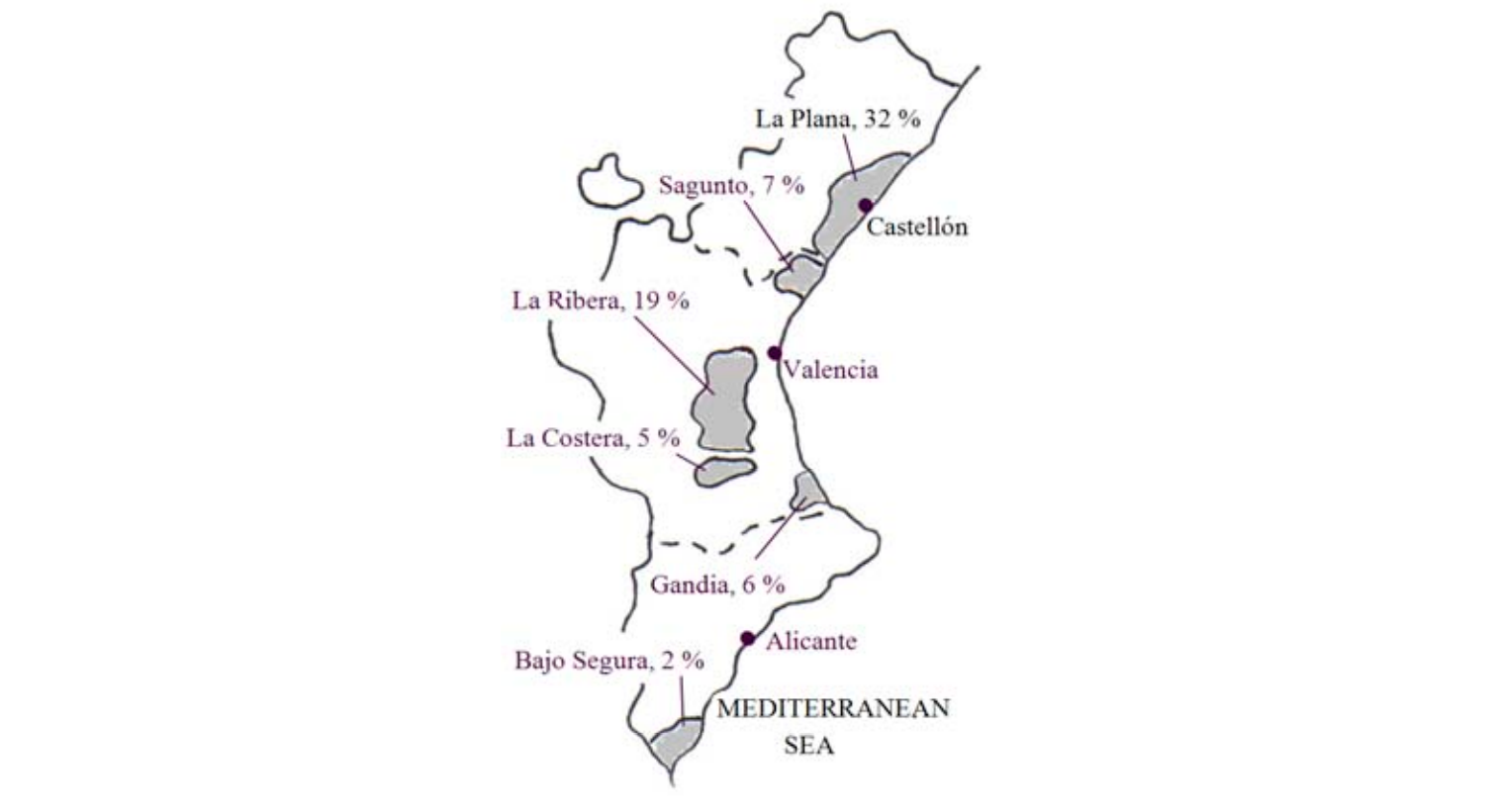
It is well known that Spain became the world’s leading exporter of horticultural products during the first third of the 20th century (Pinilla & Ayuda, 2010). From the point of view of macroeconomic performance, there seems to be a certain consensus on the positive effects of such model, at least if we look at the improvements in the levels of agricultural production and productivity (Simpson, 1994), its contribution to national product (Calatayud, 2011; Palafox Gamir, 1983) or the expansion of horticultural products exports towards high-income countries (Gallego & Pinilla, 1996; Pinilla & Ayuda, 2010). Focusing on oranges, the primacy of production was in two main regions: La Ribera, in the province of València; and La Plana, in the province of Castelló (Fig. 1). Such an agricultural development was possible mainly due to three fundamental characteristics that had been developing in those provinces from the central years of the 19th century: a turn towards intensive cultivation, productive diversification, and a marked commercial orientation, undoubtedly favored by an increasing tendency towards a more diversified diet in higher-income countries, as well as a geographical location that facilitated access to them (Calatayud, 2011). In fact, the differential return among the various types of crops appears to be one of the key factors underlying both the dynamism of supply and the productive diversification that characterized the model. It may also help explain the divergent trajectory in the evolution of inequality compared with other parts of the world where the cash-crop production model predominated (Easterly, 2007; Sokoloff & Engerman, 2000). The configuration of this triangle relied on a very particular social structure characterized by the coexistence of two agricultures (Palafox Gamir, 1984): that of small tenants who knew the land and the techniques needed to make it productive; and that of large landowners who, although not completely absentees, generally managed their land indirectly through leasing or sharecropping to individuals in the former group.
However, the distributive implications of the Valencian model have been a subject of debate. Some early interpretations defended a pessimistic vision, which spoke of very limited economic effects on the territory and the domination of local productive structures by foreign importers thanks to the negotiating power that they exercised within the export chain (Bono, 1974). Such interpretations were later qualified by Palafox Gamir (1983, 1985), who defended not only that the model had positive effects, but also that its materialization responded to the incentives that the conjuncture offered to Valencian landowners and merchants in terms of profitability. Then, and although the economic situation of the lowest levels of the productive structure was often precarious —both because of the seasonal nature of orange growing and because of the crises generated by the occasional decline in export activity provided the dependence on foreign markets— evidence on specific areas seems to point to the fact that the presence of unions, cooperatives and other organizations allowed rural workers to achieve relatively good working and remunerative conditions (Calatayud, 1986) and even the ability to accumulate capital (Garrido, 1999), in clear contrast to the situation in latifundist Spain. In fact, it has been estimated that there existed an advantage in terms of real wages growth for both skilled and unskilled urban workers in the Valencian provinces with respect to the average of Spain and the rest of the Mediterranean provinces since 1900. In the case of agricultural workers, the available estimations point out that the province of Castelló registered considerably a higher rate of growth in real than the national average and the average of the rest of Spanish regions between 1914 and 1925, as well as the largest level of real wages of the whole country in 1925 (Rosés & Sánchez-Alonso, 2004).
FIGURE 1
Percentage of land devoted to orange growing
in the main Valencian orange-growing areas in 1922
Source: Garrido (2007).
It has been pointed out that unravelling the net effect of export agriculture on the welfare of agrarian workers in producing countries needs to pay specific attention to the characteristics of land access institutions, as well as to the ability of certain actors to extract rents in the productive process (Chilosi & Federico, 2024). With regard to the first factor, it is necessary to consider the particularities of land ownership in the context under study. A fundamental feature of property institutions in the Valencian model is the fact that tenants did not assume the risks involved in direct exploitation through leasing, but could instead influence the economic logic of farming through certain contractual and extra-contractual conditions (Peris Albentosa, 1995: 504). Indeed, one of the differentiating characteristics of the model was the particular relationship between owners and tenants in areas where irrigation was predominant. The technical demands that Valencian horticulture required given the physical conditions, not only prevented the proliferation of absenteeism on the part of the owners, but also encouraged the stability of the leases and with it the realization of improvements by the tenants that eventually had to be paid by the owners. This process ultimately became a sort of silent purchase (Garrido & Calatayud, 2007, 2011), since the long horizons that fostered the stability described above tended to facilitate eventual access to the property by tenants. Furthermore, as Garrido (1999) convincingly argues, the economic conditions of Valencian agriculture underwent significant changes during the second half of the 19th century. Although it might appear that small farmers would have favored cereal cultivation —given its greater reliance on labor, the production factor most abundant to them— they instead overwhelmingly chose crops that were more capital-intensive. This apparent contradiction can be explained by the constraints imposed by the evolving market conditions. From the perspective of the labor market, citrus cultivation offered a more dynamic environment on both the supply and demand sides, as it was common for small landowners to work their own land while also selling their labor to other landowners. This flexibility contrasted with the more complex and expensive production of other non-food crops, such as hemp or silk, that made them increasingly less profitable in relative terms, despite the historical significance they had had within the Valencian economy since the Modern Era (Calatayud & Ruiz-Llopis, 2024; Garrido, 2005). On the product market side, the strong demand for citrus fruits from northern Europe provided a source of income that was difficult to match with other agricultural products. As Garrido (1999: 215) notes when referring to both types of markets, “the orange tree had the advantage of making both things easier” and, thus, the transition to citrus farming was the only option for a vast majority.
Although the consequences of these characteristics on the purchasing power of agrarian workers remain unclear, this situation provided small tenants with sources of income that created incentives to introduce improvements in agricultural productivity and, presumably, improve their material living conditions. In fact, there is evidence showing that the living conditions of Valencian peasants improved during the period. The average height in the Valencian Country followed a general trend of growth in cohorts born after 1840 (Puche-Gil, 2011) and it seems established that the geographic and socioeconomic context were crucial factors in determining the height of individuals (Ayuda & Puche-Gil, 2014). Thus, and even though the externalities of industrialization could have had a negative effect on living standards in cities with a high manufacturing presence4, the unbeatable situation imposed by the climatic context could have triggered different situations in areas of the Valencian territory mainly devoted to agriculture (Galofré-Vilà et al., 2018). In fact, municipalities specialized in irrigated agriculture experienced greater growth in the average height of their individuals. Access to land seems to be a determining factor, since landless farm workers had a lower average height than land-owning farmers, at least during the early stages of the development of intensive agriculture (Ayuda & Puche-Gil, 2017). Indeed, there seems to be a biological asymmetry between dryland and irrigated areas: the comparative advantage of the latter is to be found precisely in a more intensive use of the land, which resulted in high agricultural productivity in a greater variety of crops, which ultimately also allowed for a greater food supply and therefore the intake of a more varied diet (Ayuda & Martínez Carrión, 2022: 612).
2.2. Borriana as the epitome of the model
Within the area of La Plana, in the province of Castelló, the city of Borriana (Fig. 2) positioned itself as one of the leading cities in orange production and export. Although it is difficult to estimate figures of orange production at the municipal level, the data relating to the quantity of oranges shipped through the Borriana shore may be useful to understand the position of the city and its immediate area of influence within the Valencian and the Spanish context. As shown in Figure 3, oranges shipped from Borriana accounted for around a third of the total Valencian orange production during its period of greatest expansion. Although this does not necessarily indicate that all the oranges originated within the municipality —since some may have been cultivated in neighboring municipalities— it nevertheless provides an indication of the city’s prominence in terms of orange exports. The reasons for this must be sought in the conjunction of geographical factors with an institutional context that gave rise to a very favorable situation for intensive agriculture.
The first series of reasons has to do with the physical characteristics of the municipality of Borriana, that make it extremely suitable for orange production. Located in the southern part of the province of Castelló, in the center of the plain that constitutes the southern area of La Plana (la Plana Baixa), the city of Borriana is largely devoid of natural features that in neighboring municipalities limit the maximization of arable land. Unlike in municipalities such as Almassora or Vila-real, where rivers and ravines interrupt the continuity of arable surfaces, or the southwestern municipalities, which are shaped by the foothills of the Serra d’Espadà mountain range, Borriana’s landscape is characterized by its flatness. Furthermore, its municipal area runs parallel to the coastline, contributing to a high degree of landscape uniformity, which makes it particularly well-suited for agriculture. This stands in contrast to most municipalities in the area, whose territories extend perpendicularly inland from the coast, resulting in greater soil irregularities and topographical variation, thus reducing their agricultural potential. In addition, the edaphological characteristics of Borriana include significant anthropogenic modifications aimed at improving the soil since the 18th century (Aparici Vilar, 1993). Finally, the existence of a swampy area in Borriana still in the 19th century, gave it an important comparative advantage over other municipalities of similar size that did not have marshland, such as the neighboring Vila-real, since it was able to benefit of a convergence effect in the number of cultivated hectares and, eventually, in agricultural production, having been able to convert a large amount of previously barren land to irrigation. In 1887, 67% of the total irrigated area in Borriana was already dedicated to the cultivation of orange trees5, a figure very similar to the 64% occupied in Vila-real (Garrido, 1999: 206), suggesting that both villages followed very similar trajectories in terms of crop transition. However, if we look at the figures in absolute terms, we see how the planted area in Borriana was of 2,796 hectares, almost double of that of Vila-real, even though the latter had a much larger population.
From an institutional perspective, a distinctive feature of the municipality is related to the characteristics of its agrarian rent contracts. In Borriana, the Church had accumulated large tracts of land in the municipal area during the Modern Era. As Barrera Aymerich (1988) shows, this accumulation of land was caused by the need of the clergy to find new profitable investments in the face of the profitability problems presented by credit, which had been its main form of financing until then. The accumulation of lands by the clergy was particularly intense during the last two decades of the 18th century. This process had as its main result the dispossession of a large part of the peasants, who now became tenants of the new property of the clergy, who did not hesitate to exercise their monopolistic power to extract rents that did not always correspond to the quality of the land. This created a situation of social polarization between the Church, which increased its wealth through land rent, and a large part of the workers who were deprived of it (Obiol Menero, 1988). In the course of the 19th century, the lands that had belonged to the Church in the Modern Era and that had been released in the process of disentailment were parcelled out and transformed into fertile land. The land was distributed among a few owners, but tenants would carry out the plantation on behalf of them and enjoy the properties for free while the trees grew, allowing them to accumulate savings. Some accounts describe that these savings enabled tenants in Borriana to acquire land and eventually attain a relatively good level of material welfare (Garrido Juan, 1943: 74)6. Furthermore, the characteristics of the agrarian contracts prevalent in the area may have also played an important role in defining the power position of tenants versus owners. Landowners were faced with a series of incentives the only solution to which were fixed-rent contracts that paid tenants compensations for the improvements they introduced to the land (Garrido & Calatayud 2007, 2011). In a context of high agricultural specialization, the compensation for improvements was so high that few landowners were willing to pay it to evict the tenant and free up the land. In practice, this favored the long-term stability of tenants and, in many cases, eventually reinforced the process of land purchase by peasants. Thus, the customary conditions during the 19th century created a favorable situation for the tenants, allowing them to accumulate savings with which they could acquire land in previously uncultivated areas that allowed for the introduction of orange trees and the progressive improvement in its cultivation. It is no coincidence that Garrido (1999) argued that the phenomenon of peasantization through land access took place in a particularly intense and rapid manner in municipalities of La Plana such as Borriana. It seems reasonable, therefore, to raise the possibility that the quality of life of the people living in Borriana improved thanks to changes in the conditions of farming, and that this could have been a successful example of distributing the benefits to the lower layers of the population, thanks precisely to the increasing ability of laborers to access land property.
FIGURE 2
Location of Borriana within Spain and the Valencian Country
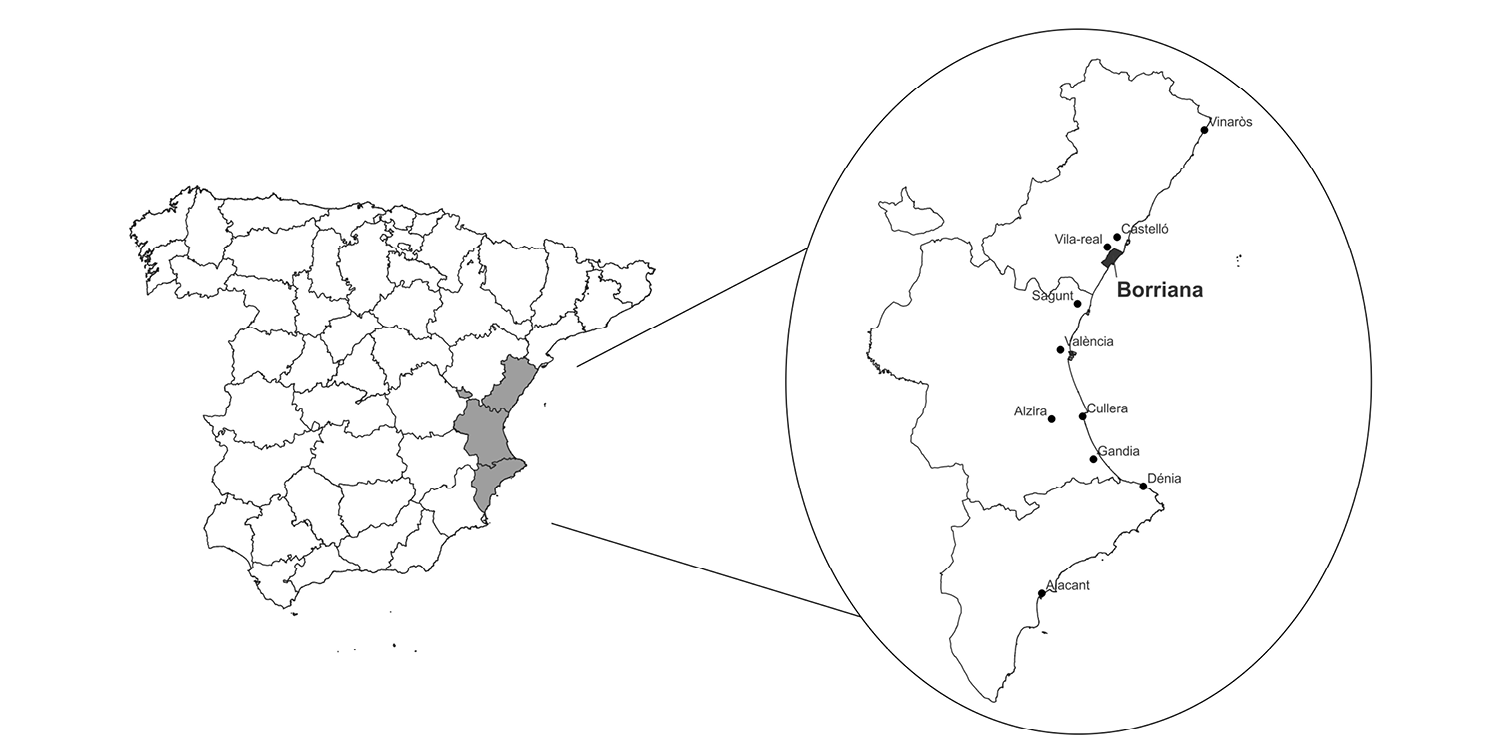
Source: own elaboration using shapefiles from Instituto Geográfico Nacional (IGN).
FIGURE 3
volution of orange exports from Borriana shore and the proportion it represented out of total Valencian exports, 1861-1914
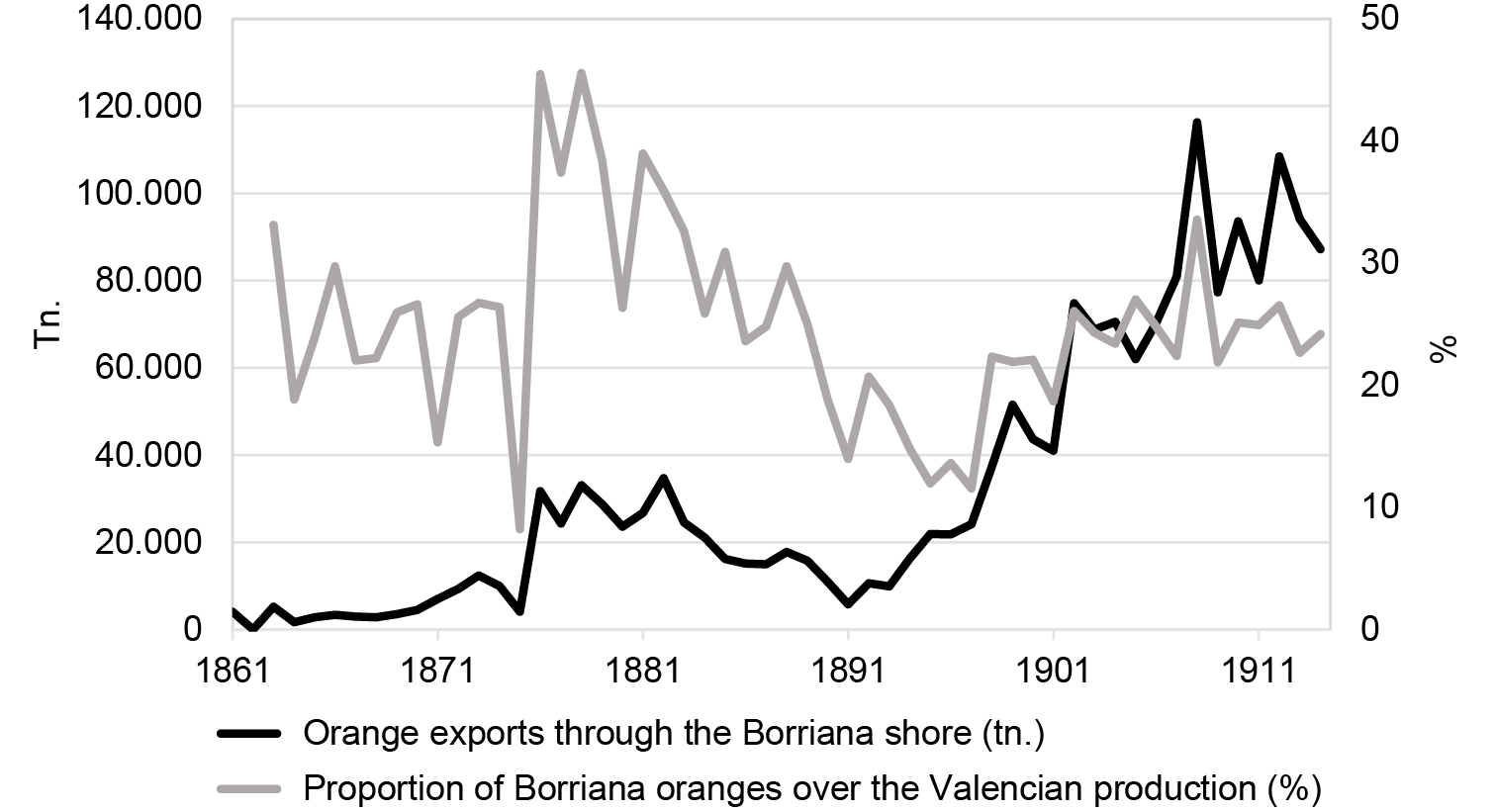
Source: Piqueras Haba (1985).
3. SOURCES AND DATA
The documentary base of this study are the lists of the electoral register (censo electoral) that Spanish municipalities were required to compile following the definitive introduction of universal suffrage in Spain in 1890. The law established the right to active suffrage for all Spanish men over twenty-five who had lived in a Spanish municipality for at least two years. To make this right effective, the law provided for the creation of an electoral administrative system of boards (juntas electorales) at various levels (central, provincial and municipal) that would be in charge of managing the electoral register. From the point of view of the reliability of the data, this is a very important characteristic since it was local authorities themselves who were in charge of compiling the list of voters. Thus, the system began at the lowest level, that of the municipality, with mayors (alcaldes) who were responsible for drawing up the electoral register each year, taking into account the changes that could result from deaths, emigration out of or immigration into the municipality, as well as managing potential claims in case of errors and inaccuracies. Thus, each year the mayor of each municipality prepared a list of voters indicating their age, address, current occupation, ability to read and write and whether they had the right to passive suffrage within the municipality, as stipulated in the 1877 Municipalities Law (Ley de Municipios).
I digitized the electoral register of Borriana for years 1895, 1905 and 1915, in order to maintain a certain temporal separation between the observations and thus be able to better observe the possible changes in the occupations of the individuals that make them up. Thus, my database consists of all males who had the right to vote in Borriana, for each of whom I know their full name, age, current address, occupation and whether they were able to read and write7. In the electoral register corresponding to years 1895 and 1905, the address field only indicates the name of the street, while in the 1915 register the house number is also reported. A careful reading of the source allows us to infer an additional piece of information that has to do with the location of the address within the municipality and, specifically, whether the address was located in the urban center or scattered in the fields throughout the municipal area8. An inherent limitation of this source is that it does not provide information on the number of individuals who migrated out of the municipality —a phenomenon that, in some cases, may have been driven by economic factors. Consequently, if out-migration was particularly significant, the data may be subject to survival bias. However, to the best of our knowledge, there is no available source that reliably captures the scale of migration at the municipal level, let alone the specific causes of such movements at the individual level.
Provided that my main interest lies in the occupation of individuals, I have coded the profession reported in the source following a criterion based on the HISCLASS classification (Leeuwen & Maas, 2011), but with slight modifications. In general, I have based myself on the 12 occupational categories described in the HISCLASS classification, but I have collapsed it to 7 broad categories, as shown in Table 1. In addition, I have introduced some modifications to adapt it to the socioeconomic specificities of the Valencian model of intensive agriculture. There are two main changes. Firstly, I consider landowners (those who declare propietario as their occupation) as part of the classification, and I include them in category 1 along with managers and liberal professionals. Secondly, I divide the category of low-skilled agricultural workers into two to differentiate between the laborer (jornalero) and the tenant (labrador). This is a crucial difference in the position of individuals within the agricultural production system and is precisely the most relevant piece of information on which I base my analysis.
According to Garrido (1999: 214), in the specific case of the municipalities of La Plana, the self-inclusion of an individual within one category or another seems to respond above all to the degree to which they perceived themselves as self-sufficient and, thus, not dependent on others. Of course, this does not imply that a laborer could not own some land, nor that a farmer had to be exclusively a wage earner. However, I assume that in general the perception of self-sufficiency was defined above all by the fact of owning land or not —even if the amount of land owned forced the head of the family to work for others occasionally— and, therefore, that the categories reported in the source were strongly conditioned by this fact. Thus, the modified HISCLASS classification that I propose in this article has seven categories, including one for those who are outside the labor force. However, I will restrict the sample by excluding from the analysis category 7, which represents individuals who are outside of the labor force. Table 1 shows the categories of such classification, as well as some examples of the reported professions that are included in each of them.
I then applied a matching strategy to link the same individuals who appear in more than one census. In order to be able to observe the same individual on at least two different occasions in time, I construct two linked samples: one for the individuals that appear in 1895 and 1905, and another for the individuals that appear in 1905 and 1910. Given the information available for each individual as reported in the source, my matching strategy is based on two fundamental criteria: name and age. First, I have matched all individuals whose name, first and second surnames are the same in the different censuses. Once I have identified all observations that could correspond to the same person in the different censuses due to having the same name and surnames, I check whether they actually correspond to the same person on the basis of their stated age. If an individual declared an age x in a particular census year, then its age in the census carried out 10 years later should be around x + 109. Of course, this is not always the case. The literature has repeatedly pointed out the existence of an age-heaping phenomenon, that is, of age misreporting (Beltrán Tapia et al., 2022). Therefore, I do not expect the age reported by the individuals to be precisely the one that would correspond to an interval of ten years having elapsed. This is because they could have reported it incorrectly in the first census and correctly in the subsequent one, or simply because they could report it incorrectly in a systematic way. Therefore, I consider that two people with the same name and surname are the same if their ages are within an interval of years from the age that would correspond according to what was declared in the census in which they first appear.
TABLE 1
HISCLASS-7 classification as proposed for this article
| HISCLASS category | # | Examples of occupations included |
|---|---|---|
| Landowners, managers and liberal professions | 1 | Landowner (propietario) Lawyer (abogado) Doctor (médico) |
| White-collar workers and higher-level professionals | 2 | Veterinarian (veterinario) Trader (comerciante) Industrialist (industrial) |
| Artisans, employees and lower-level professionals | 3 | Employee (empleado) Cobbler (zapatero) Baker (panadero) |
| Non-agrarian low-skilled workers | 4 | Innkeeper (tabernero) Seaman (marinero) Builder (albañil) |
| Agrarian low-skilled workers | 5 | Tenant (labrador) Laborer (jornalero) |
| Out of the labor force | 6 | Student (estudiante) Retired (jubilado) |
Source: see text.
The result of imposing both criteria is two linked samples composed of individuals who meet the name and age requirements between the different censuses: one for the first intercensal period (1895-1905) and another for the second (1905-1915). Table 2 shows some descriptive statistics on the individuals contained in each of the linked samples. As we can see, in the two intercensal periods the professional categories with the most individuals are agricultural occupations, with a greater preponderance of the presence of tenants (category 5). As we can see, the number of laborers (category 6) is considerably reduced (from around 19% to 12% of the linked individuals) between one period and the other. As far as the rest of the occupational categories are concerned, we can observe that other professional categories such as artisans, employees and non-agrarian lower-level professionals are also frequent, although at much lower levels than the agricultural professions. Another interesting observation results from the evolution of literacy, which increases notably between the two inter-census periods, from 27% to 45%. The distribution by age groups shows a fairly uniform distribution between 25 and 65 years. Finally, the distribution of individuals by place of residence indicates that most of them lived in the urban center.
TABLE 2
Characteristics of the individuals in the matched samples
| First intercensal period (1895–1905) | Second intercensal period (1905–15) | ||||
|---|---|---|---|---|---|
| No. | % | No. | % | ||
| Occupation | |||||
| Category 1 | 14 | 0.88 | Category 1 | 13 | 0.83 |
| Category 2 | 83 | 5.22 | Category 2 | 76 | 4.83 |
| Category 3 | 126 | 7.92 | Category 3 | 157 | 9.97 |
| Category 4 | 130 | 8.17 | Category 4 | 132 | 8.39 |
| Category 5 | 908 | 57.07 | Category 5 | 921 | 58.51 |
| Category 6 | 301 | 18.92 | Category 6 | 188 | 11.94 |
| Category 7 | 29 | 1.82 | Category 7 | 87 | 5.53 |
| Literacy | |||||
| Yes | 436 | 27.4 | Yes | 711 | 45.17 |
| No | 1,155 | 72.6 | No | 863 | 54.83 |
| Age | |||||
| 25–34 | 14 | 0.88 | 25–34 | 30 | 1.91 |
| 35–44 | 445 | 27.97 | 35–44 | 408 | 25.92 |
| 45–54 | 427 | 26.84 | 45–54 | 433 | 27.51 |
| 55–64 | 315 | 19.8 | 55–64 | 337 | 21.41 |
| 65–74 | 161 | 10.12 | 65–74 | 168 | 10.67 |
| 75 or more | 62 | 3.9 | 75 or more | 60 | 3.8 |
| Residence | |||||
| City | 1,309 | 82.28 | City | 1,392 | 88.44 |
| Disseminated | 282 | 17.72 | Disseminated | 182 | 11.56 |
| Total | 1,591 | 100 | Total | 1,574 | 100 |
Note: literate individuals are defined as those who know how to read and write.
Source: see text.
4. THE DYNAMICS OF OCCUPATIONAL MOBILITY THROUGH THE LIFE CYCLE
I now focus my analysis on the dynamics of changes in occupational categories reported by the individuals. Table 3 shows the transition matrix for all individuals matched in the first intercensal period, that is, between 1895 and 1905. Each cell represents the amount of individuals employed in each occupational category in 1895 who ended up in the different occupational categories in 1905. Percentages are calculated over the row totals, thus representing the fraction of individuals in a specific category in 1895 who ended up in the different categories in 1905.
TABLE 3
Transition matrix for the first intercensal period, 1895-1905
| HISCLASS in t−1 | 1 | 2 | 3 | 4 | 5 | 6 | Row total |
|---|---|---|---|---|---|---|---|
| 1 | 1.00 (12) |
0.00 | 0.00 | 0.00 | 0.00 | 0.00 | 1 (12) |
| 2 | 0.00 | 0.96 (75) |
0.00 | 0.00 | 0.01 | 0.03 | 1 (78) |
| 3 | 0.00 | 0.01 (1) |
0.95 (112) |
0.00 (2) |
0.02 | 0.03 | 1 (118) |
| 4 | 0.00 | 0.00 (1) |
0.04 | 0.94 (124) |
0.02 | 0.00 | 1 (132) |
| 5 | 0.00 | 0.00 | 0.01 | 0.03 | 0.93 (830) |
0.01 (51) |
1 (896) |
| 6 | 0.00 (0) |
0.01 (1) |
0.02 (6) |
0.20 (62) |
0.00 | 0.78 (246) |
1 (317) |
| Column total | 0.01 (12) |
0.05 (81) |
0.08 (126) |
0.08 (130) |
0.58 (900) |
0.20 (304) |
1 (1,553) |
Note: percentages are calculated over the row totals. Individuals out of the labor force in or are excluded.
Source: own elaborations.
As in any transition matrix, the position with respect to the main diagonal determines the characteristics of the observed mobility. Specifically, all those individuals located above the main diagonal suffered downward occupational mobility, while all those individuals located below it would enjoyed upward occupational mobility. There are several interesting insights this table suggests. The first noticeable characteristic is the large degree of occupational immobility (stasis), as shown by the fact that for all but one 1895 categories the percentage of individuals who remained in the same category in 1905 (or, in other words, those located in the main diagonal of the matrix) is larger than 90% in each category, with agrarian laborers being the only exception. Interestingly, this occupational category escapes from this pattern because 20% of agrarian laborers in 1895 end up being tenants in 1905, which is the phenomenon of our starting hypothesis. It is also worth noting the existence of a certain mass of tenants who become workers, although their incidence in absolute terms is much lower than that of the opposite movement (6% vs. 20%). Beyond that, we observe some cases of upward mobility in individuals who leave the agrarian professions to become both artisans, employees and lower-level professionals and non-agrarian low-skilled workers; as well as cases of individuals who from these last categories ended up becoming agricultural workers.
TABLE 4
Transition matrix for the second intercensal period, 1905-1915
| HISCLASS in t−1 | 1 | 2 | 3 | 4 | 5 | 6 | Row total |
|---|---|---|---|---|---|---|---|
| 1 | 1.00 (10) |
0.00 | 0.00 | 0.00 | 0.00 | 0.00 | 1 (10) |
| 2 | 0.03 (2) |
0.53 (38) |
0.16 | 0.01 | 0.15 | 0.12 | 1 (71) |
| 3 | 0.00 | 0.05 (8) |
0.68 (86) |
0.01 | 0.20 | 0.05 | 1 (129) |
| 4 | 0.00 | 0.00 (5) |
0.07 (9) |
0.56 (71) |
0.25 (30) |
0.07 (9) |
1 (124) |
| 5 | 0.00 (1) |
0.02 (13) |
0.04 (29) |
0.06 (37) |
0.76 (581) |
0.10 (96) |
1 (757) |
| 6 | 0.00 (0) |
0.02 (9) |
0.05 (20) |
0.06 (21) |
0.69 (265) |
0.18 (71) |
1 (386) |
| Column total | 0.01 (13) |
0.05 (73) |
0.08 (155) |
0.08 (131) |
0.58 (918) |
0.13 (187) |
1 (1,477) |
Note: percentages are calculated over the row totals. Individuals out of the labor force in or are excluded.
Source: own elaborations.
If we consider the second period, the image is largely different. Table 4 shows the transition matrix for all individuals matched between 1905 and 1915. The degree of occupational immobility has decreased, as the percentage of people staying in the same occupational category is now way lower for all categories but one, as evidenced by the decrease in the percentages of the main diagonal. Again, landowners do not change their position. The most extreme case is that of laborers: only 18% of those who were in this category in 1905 remained as such in 1915, confirming the occupational mobility in agrarian workers that we started to see during the first period. The relative number of tenants who stay as such is lower than in the previous phase (76% vs. 93%). Although there is a 13% of workers who were tenants in 1905 and become laborers in 1915, it represents a small amount in absolute terms. Another interesting dynamic is the mobility that occurred in all non-agricultural occupational categories (except that of landowners, managers and liberal professions) towards the tenant category, as evidenced by the fact that 21% of those in category 2, 20% of those in category 3 and 25% of those in category 4 in 1905, became tenants in 1915. This allows us to speculate that perhaps intensive agriculture became an interesting career option for individuals who had previously been engaged in humble, non-agrarian occupations. For the rest of categories, upward mobility remained residual, with percentages under 10% in all categories.
In order to delve deeper into these results, I perform an empirical analysis that allows me to consider also the personal information of each individual. My empirical strategy is similar in spirit to that of Alston and Ferrie (2005) for the analysis of career mobility in agriculture in the south of the United States during the first third of the 20th century. In particular, I am interested in estimating the probability of an individual ending up in a specific occupational category conditional both to his occupational category in the past and other personal characteristics. As my main interest lies in knowing the movements between the two agrarian occupation categories, as well as between these two categories and the rest of the non-agricultural occupations, I collapse the aforementioned occupational classification into three categories: non-agricultural jobs (comprising categories 1, 2, 3 and 4), tenants (comprising category 5) and laborers (comprising category 6). To estimate the probability of an individual ending up in a particular occupational category, I estimate a multinomial logit (MNL) model for each of the two linked samples, that is, for the 1895-1905 sample and for the 1905-15 sample. For the two models, my main dependent variable is the occupational status of an individual in the current census, and my main explanatory variable is the career status of the individual in the previous census. In addition, I control for several personal characteristics, such as age, whether the individual was able to read and write, as well as the location of his residence within the municipal territory, namely the voting district and whether his place of residence was disseminated or located in the urban center.
Table 5 presents the results of the MNL model for the first period, that is, between 1895 and 1905. Model I does not include voting district and dissemination habitation fixed effects, while model II does. Models IIa, IIb and IIc provide the average marginal effects (AMEs) of model II for the three possible category outcomes in the model: non-agrarian jobs (IIa), tenant (IIb) and laborer (IIc). In MNL models, the average marginal effects must be understood as the change in the probability of ending up in each of the respective categories, holding all other factors equal, expressed in percentage points. Thus, the coefficients in columns IIa, IIb and IIc can be interpreted as the change in percentage points of the probability to end up in each of the three outcome categories if the starting point was the independent variable category.
As we can see, the results are in line with a situation of relatively high occupational immobility among the job categories. Column IIa indicates that having an agricultural profession in 1895 implied very few chances of transitioning to a non-agrarian occupation in 1905: being a tenant or a laborer was associated with more than 90 percentage points less probability of becoming a non-agrarian worker than those who already had a non-agrarian occupation. This finding goes in line with the fact that, at this early stage of the development of intensive agriculture in which the agricultural export transformation of the city had not yet fully materialized, the barriers to movement between agricultural and non-agricultural occupations were still very high.
TABLE 5
MNL estimation results for the first intercensal period, 1895-1905
| HISCLASS in t−1 (Non-agrarian = base) |
I | II | IIa Non-agrarian ∂Pr/∂Xj |
IIb Tenant ∂Pr/∂Xj |
IIc Laborer ∂Pr/∂Xj |
||
|---|---|---|---|---|---|---|---|
| Coefficient | Coefficient | ||||||
| Tenant | −7.881*** (0.490) |
−8.218*** (0.532) |
−0.937*** (0.013) |
0.903*** (0.013) |
0.034*** (0.031) |
||
| Laborer | −5.549*** (0.539) |
−5.872*** (0.602) |
−0.519*** (0.019) |
0.019 (0.028) |
0.030 (0.030) |
||
| Literacy in t−1 | 1.074*** (0.360) |
1.057*** (0.376) |
0.026*** (0.009) |
−0.030*** (0.009) |
0.004 (0.007) |
||
| Age in t−1 | 0.014 (0.138) |
0.017 (0.141) |
0.002 (0.003) |
−0.001 (0.003) |
0.000 (0.002) |
||
| Disseminated in t−1 | −0.820 (0.802) |
−2.393*** (0.821) |
−0.022 (0.033) |
0.020 (0.033) |
0.002 (0.030) |
||
| Constant | 3.0148*** (0.802) |
2.953** (0.904) |
|||||
| Voting district FE | N | Y | |||||
| Disseminated FE | N | Y | |||||
| Observations | 1,553 | 1,553 | |||||
| Pseudo-R² | 0.6622 | 0.6702 | |||||
| Log-pseudolikelihood | −507.97 | −495.85 | |||||
| Wald χ² | 847.54*** | 840.15*** | |||||
Note: robust standard errors in parentheses. Levels of significance: * p < 0.1, ** p < 0.05, *** p < 0.01.
Source: own elaborations.
If we focus our attention on the coefficients associated to the probability of ending up in agrarian jobs, we see how the mobility between these occupations is slightly higher, although here I also find large levels of stasis: the general trend is that individuals are more likely to remain in the same job category. Always considering non-agrarian occupations as the base category, the fact of being tenants in 1895 made individuals 90 percentage points more likely to remain as such in 1905, while only 3 percentage points more likely to end up as laborers, that is, suffering downward mobility. In the case of laborers, I also observe how the likelihood of remaining in the same category is high (72 percentage points more likely to end up in the same category), but in this case the door is open to upward mobility: these individuals were 19 percentage points more likely than non-agrarian workers to become tenants, that is, enjoying upward mobility in the agricultural ladder.
The only individual characteristics that seem to have a significant effect on the probabilities of ending up in each of the different professional categories are literacy and the fact of living in a disseminated area. Being literate is associated with an increase in the probability of ending up in a non-agrarian occupation of around 2 percentage points and with a decrease in the probability of ending up being tenant of around 3 percentage points with respect to non-agrarian workers. In this sense, and although the magnitude is not high, the sign of the effect seems to indicate that literacy could constitute a way out of agricultural occupations to non-agricultural ones, as it was the case in urban areas (Beltrán Tapia & de Miguel Salanova, 2020). Living in a disseminated area, in turn, is associated with a 5 percentage points decrease in the probability of ending up in a non-agrarian profession and an 8 percentage points increase in the probability of being tenant. These results would be in line with the fact that most non-agricultural occupations were carried out in the urban center of the city. On the other hand, the close connection of agrarian workers with the land plots that the particular property institutions favored that farmers and their families chose to live near the fields and not in the urban center, as happened in other irrigated areas of the Valencian countryside (Torres Faus, 2021). The age of the individuals does not seem to have a significant effect on the probability of occupational category changes.
Analyzing the situation during the second period allows us to understand if occupational mobility improved or not during a stage of development of intensive agriculture. Table 6 presents the results of the same estimation for the period between 1905 and 1915. As we can see, in this second period the situation of occupational mobility has largely changed with respect to the previous one. The first noticeable phenomenon is that, although the probability of ending up in a non-agricultural profession for agricultural workers is still negative, the magnitude of the reduction in the probability of securing a non-agrarian job is smaller, suggesting that being an agricultural worker now has much a less adverse impact in the perspectives of upward mobility. Indeed, now the probability of ending up in a non-agrarian job for both tenants and laborers is just 50 percentage points less than for non-agrarian workers, as opposed to the circa 90 percentage points less in the previous period. The picture of occupational mobility within agrarian jobs is also very different. Tenants are now far less likely to remain as such (around 50 percentage points more likely as opposed to 90 percentage points in the previous period), while chances of ending up as laborers remain unchanged at around 3 percentage points more likely with respect to non-agrarian workers.
TABLE 6
MNL estimation results for the second intercensal period, 1905-1915
| HISCLASS in t−1 (Non-agrarian = base) |
I | II | IIa Non-agrarian ∂Pr/∂Xj |
IIb Tenant ∂Pr/∂Xj |
IIc Laborer ∂Pr/∂Xj |
||
|---|---|---|---|---|---|---|---|
| Coefficient | Coefficient | ||||||
| Tenant | −3.066*** (0.189) |
−3.102*** (0.191) |
−0.528*** (0.030) |
0.490*** (0.030) |
0.038*** (0.021) |
||
| Laborer | −2.471*** (0.224) |
−2.505*** (0.229) |
−0.439*** (0.037) |
0.364*** (0.038) |
0.075*** (0.026) |
||
| Literacy in t−1 | 0.878*** (0.174) |
0.872*** (0.176) |
0.127*** (0.027) |
−0.060* (0.032) |
−0.067** (0.021) |
||
| Age in t−1 | −0.040*** (0.008) |
−0.040*** (0.008) |
−0.004*** (0.001) |
0.005*** (0.001) |
−0.001*** (0.001) |
||
| Disseminated in t−1 | −1.298*** (0.310) |
−1.520*** (0.319) |
−0.137*** (0.027) |
0.083*** (0.032) |
0.053** (0.021) |
||
| Constant | 32.580*** (0.379) |
2.211*** (0.396) |
|||||
| Voting district FE | N | Y | |||||
| Disseminated FE | N | Y | |||||
| Observations | 1,477 | 1,477 | |||||
| Pseudo-R² | 0.2188 | 0.2457 | |||||
| Log-pseudolikelihood | −1043.72 | −1007.72 | |||||
| Wald χ² | 383.20*** | 438.38*** | |||||
Note: robust standard errors in parentheses. Levels of significance: * p < 0.1, ** p < 0.05, *** p < 0.01.
Source: own elaborations.
Changes are more drastic for laborers. The timid upward mobility in the agricultural ladder from laborers to tenants that we observed in the previous period is consolidated, as laborers are now more likely to become tenants (around 40 percentage points more likely as opposed to 19 percentage points in the previous period). In addition, stasis is significantly reduced, since laborers are now far less likely to end up in the same occupational category: they are only around 7 percentage points more likely, as opposed to the 73 percentage points more likely they were in the previous period. Taken together, these results are compatible with the peasantization hypothesis proposed by Garrido (1999): the conditions of access to land by laborers gradually increased, even if it was in the form of improved contractual rent conditions or the acquisition of small properties.
In addition, in this period all personal characteristics considered in the model seem to have a significant effect on the change in the estimated probabilities. First, literacy seems to exert a particularly strong effect in occupational mobility: it appears to be associated to a 13 percentage points increase in the probability of ending up in non-agrarian jobs, while it is associated to a 6 percentage points decrease in the probability of ending up as a tenant and a 7-percentage point decrease in the probability of ending up as a laborer. Thus, as we found in the previous period, the accumulation of human capital through literacy seems to be associated with movements from the agrarian sector to non-agrarian occupations. The age of the individuals is now a significant factor, as opposed to the situation in the previous intercensal period. As we can see, older individuals are less likely to end up in non-agrarian jobs but more likely to end up being tenants. These two results are in line with two reasons that we have already pointed out above. Firstly, if the accumulation of human capital facilitated access to non-agricultural professions, then it is likely that this movement took place at an early age rather than later in life. Secondly, the long horizon involved in acquiring land through the silent purchase (Garrido & Calatayud, 2007, 2011) makes it very likely that the transition from laborer to tenant occurred later in life. Regarding the fact of living in a disseminated area, it also seems to have a significant effect for the probability of ending up in a particular occupational group: living in disseminated habitations makes individuals around 14 percentage points less likely to end up in non-agrarian jobs, while it makes them 20 percentage points more likely to end up as tenants and 6 percentage points less likely to end up as laborers. This confirms the result that we already observed in the previous period, related to the urban nature of non-agricultural occupations and the need for physical connection with the land by those who worked it.
5. CONCLUDING REMARKS
Even though the importance of globalization has been repeatedly stressed by the literature, the evidence on its consequences on the welfare of agricultural workers in commodity-exporting countries is still scarce. We also know little about its relationship with occupational mobility and, therefore, the ability of individuals to improve their employment situation and therefore their well-being. In the case of Spain, the literature has shown a strong tendency for the intergenerational transmission of socioeconomic and occupational status, indicating a significant degree of stasis. With the aim of identifying potential deviations from this general pattern and taking advantage of the fact that during the First Globalization Spain became the largest exporter country of Mediterranean horticultural products, I investigate the distributional implications of intensive, export-oriented agriculture through the study of occupational mobility, to understand whether it was conducive to widespread climbs in the agricultural ladder. To this end, I conduct a case study of one of the most salient municipalities in which export-oriented horticultural products cultivation took place during the years in which Spain became the world’s largest orange exporter: the city of Borriana. Using data at the individual level, my results show notable changes in the dynamics of occupational mobility with increasing upward mobility both in the agricultural ladder and between agrarian and non-agrarian occupations: both tenants and laborers saw their chances of ending up in a non-agrarian occupation increase notably between 1895 and 1915, while the chances of laborers of becoming tenants also increased. I also demonstrate that individuals’ personal characteristics were relevant. A prominent factor such as literacy appears to function as a driver of occupational shifts from agricultural to non-agricultural work, while living in disseminated areas increased the likelihood of becoming a tenant and decreased the likelihood of becoming a laborer or ending up in a non-agrarian occupation, suggesting the importance of physical attachment to the land.
The case of Borriana thus provides new evidence on the living conditions of agrarian workers devoted to intensive agriculture, providing support the peasantization hypothesis by Garrido (1999) on the progressive capacity of laborers to increase their control over the land, either through the acquisition of full ownership or the signing of contracts that allowed compensation for improvements, which in the long term could facilitate access to full ownership (Garrido & Calatayud, 2007, 2011) during the transition to intensive agriculture in Mediterranean Spain. Although I am not able to quantify the extent to which access to full property actually happened in the case of Borriana, my results provide evidence of the ability of laborers to climb the agricultural ladder, which in many cases provided the incentives for the introduction of techniques that eventually improved agrarian productivity, in conjunction with other structural factors such as the cooperative movement, leading to the development of a very distinctive model of agrarian capitalism whose social dynamics had profound economic, political, and social implications (Calatayud et al., 2006). Further research should be aimed at delving deeper into the conditions under which this progressive redefinition of roles within this agrarian economy occurred. Becoming tenants was of course an important first step but establishing this is just as important as exploring what its implied in terms of welfare and prosperity for peasants and their families, both contemporaneously and in the decades that followed. Only in this way will we be able to understand the imprint that intensive agriculture left in the economic development of Mediterranean Spain.
ACKNOWLEDGEMENTS
I owe a huge debt of intellectual gratitude to the late Professor Samuel Garrido (1958-2022), with whom I shared the conversations and reflections on the history of the milieu we held in common that lie at the very origins of this work. This article would be much better if we had had the chance to discuss it together, but it would not exist at all if we had never met.
I am grateful to Salvador Calatayud, Gabriele Cappelli, Alfonso Díez Minguela and Daniel Tirado Fabregat for insightful comments and suggestions to previous drafts of the paper. I would also like to thank the Editorial Board of Historia Agraria, as well as to three anonymous referees, whose comments have greatly improved the article.
REFERENCES
Abad, Vicente (2011). Borriana, siglo xx: De la Restauración a la Guerra Civil (1901-1940). Tirant lo Blanch.
Abbott, Andrew (2006). Mobility: What? When? How? In Stephen L. Morgan, David B. Grusky & Gary S. Fields (Eds.), Mobility and Inequality (pp. 137-62). Stanford University Press.
Alston, Lee J. & Ferrie, Joseph P. (2005). Time on the Ladder: Career Mobility in Agriculture, 1890-1938. Journal of Economic History, 65(4), 1058-81. https://doi.org/10.1017/S0022050705000409
Alston, Lee J. & Kauffman, Kyle D. (1998). Up, down, and off the Agricultural Ladder: New Evidence and Implications of Agricultural Mobility for Blacks in the Postbellum South. Agricultural History, 72(2), 263-79.
Antonie, Luiza, Inwood, Kris, Minns, Chris & Summerfield, Fraser (2022). Intergenerational Mobility in a Mid-Atlantic Economy: Canada, 1871-1901. Journal of Economic History, (82), 1003-29. https://doi.org/10.1017/S0022050722000353
Aparici Vilar, Joaquim (1993). L’agricultura al terme de Borriana. Agrupació Borrianenca de Cultura-Publicacions de la Universitat Jaume I.
Atack, Jeremy (1988). Tenants and Yeomen in the Nineteenth Century. Agricultural History, 62(3), 6-32.
Atack, Jeremy (1989). The Agricultural Ladder Revisited: A New Look at an Old Question with Some Data for 1860. Agricultural History, 63(1), 1-25.
Ayuda, María I. & Puche-Gil, Javier (2014). Determinants of Height and Biological Inequality in Mediterranean Spain, 1859-1967. Economics and Human Biology, (15), 101-19. https://doi.org/10.1016/j.ehb.2014.07.003
Ayuda, María I. & Puche-Gil, Javier (2017). Biological Welfare and Nutritional Inequality in Rural Mediterranean Spain: The Irrigated Area of Valencia, 1859-1939. Revista de Historia Económica-Journal of Iberian and Latin American Economic History, 35(1), 11-47. https://doi.org/10.1017/S0212610916000185
Ayuda, María I., Puche-Gil, Javier & Martínez-Carrión, José Miguel (2022). Determinants of Nutritional Differences in Mediterranean Rural Spain, 1840-1965 Birth Cohorts: A Comparison between Irrigated and Dry Farming Agriculture. Social Science History, (46), 585-616. https://doi.org/10.1017/ssh.2022.11
Barrera Aymerich, Modest (1988). El clero secular de la Parròquia de El Salvador en la vida de Borriana dels segles xvii i xviii. Magnífic Ajuntament de Borriana.
Beltrán Tapia, Francisco J. & Miguel Salanova, Santiago de (2020). Class, Literacy and Social Mobility: Madrid, 1880-1905. History of the Family, 26(1), 149-72. https://doi.org/10.1080/1081602X.2020.1853587
Beltrán Tapia, Francisco J., Díez-Minguela, Alfonso, Martinez-Galarraga, Julio, & Tirado-Fabregat, Daniel A. (2022). Two Stories, One Fate: Age-Heaping and Literacy in Spain, 1877-1930. Revista de Historia Económica-Journal of Iberian and Latin American Economic History, 40(3), 405-38. https://doi.org/10.1017/S0212610921000033
Beneito Lloris, Ángel & Puche-Gil, Javier (2010). Creixement econòmic i desenvolupament fabril a Alcoi (1840-1915): Misèria fisiològica sota l’esplendor industrial? In Josep Lluís Santonja & Joaquim Victoriano (Eds.), La societat industrial valenciana (pp. 143-71). Centre Alcoià d’Estudis Històrics i Arqueològics.
Black, Sandra E., Devereux, Paul J., Lundborg, Petter & Majlesi, Kaveh (2020). Poor Little Rich Kids?: The Role of Nature versus Nurture in Wealth and Other Economic Outcomes and Behaviours. Review of Economic Studies, (87), 1683-725. https://doi.org/10.1093/restud/rdz038
Boberg-Fazlić, Nina, Sharp, Paul & Weisdorf, Jacob (2011). Survival of the Richest? Social Status, Fertility and Social Mobility in England 1541-1824. European Review of Economic History, 15(3), 365-92. https://doi.org/10.1017/S136149161100013X
Bono, Emèrit (1974). La base exportadora agrícola de la economía del País Valenciano y el modelo de crecimiento hacia afuera. PhD dissertation. Universitat de València.
Bourdieu, Jérôme, Ferrie, Joseph P. & Kesztenbaum, Lionel (2009). Vive la différence?: Intergenerational Mobility in France and the United States during the Nineteenth and Twentieth Centuries. Journal of Interdisciplinary History, (39), 523-57. https://doi.org/10.1162/jinh.2009.39.4.523
Bowles, Samuel & Gintis, Herbert (2002). The Inheritance of Inequality. Journal of Economic Perspectives, (16), 3-30. https://doi.org/10.1257/089533002760278686
Brea-Martínez, Gabriel & Pujadas-Mora, Joana M. (2019). Estimating Long-Term Socioeconomic Inequality in Southern Europe: The Barcelona Area, 1481-1880. European Review of Economic History, 23(4), 397-420. https://doi.org/10.1093/ereh/hey017
Calatayud, Salvador (1986). Condiciones de trabajo en la agricultura naranjera (1914-1936). Saitabi, (36), 269-88.
Calatayud, Salvador (2011). Desarrollo agrario e industrialización: Crecimiento y crisis en la economía valenciana del siglo xx. Historia contemporánea, (42), 105-48. https://doi.org/10.1387/hc.4705
Calatayud, Salvador & Millán, Jesús (2010). Las vías simultáneas del capitalismo agrario valenciano (1770-1900). In Ricardo Robledo (Ed.), Ramon Garrabou: Sombras del progreso (pp. 199-229). Crítica.
Calatayud, Salvador, Millán, Jesús & Romeo, María C. (2006). Leaseholders in Capitalist Arcadia: Bourgeois Hegemony and Peasant Opportunities in the Valencian Countryside during the Nineteenth Century. Rural History, 17(2), 149-66. https://doi.org/10.1017/S0956793306001853
Calatayud, Salvador & Ruiz Llopis, Amparo (2024). Un largo declive: La etapa final de la sericicultura valenciana, 1830-1910. Historia Agraria, (93), 65-93. https://doi.org/10.26882/histagrar.093e03g
Chilosi, David & Federico, Giovanni (2024). Globalization, Welfare, and Inequality: Evidence from Transoceanic Market Integration, 1815-1913. Journal of Global History, 19(3), 344-369. https://doi.org/10.1017/S1740022824000056
Clark, Gregory, Cummins, Neil, Hao, Yu & Diaz Vidal, Dan (2015). Surnames: A New Source for the History of Social Mobility. Explorations in Economic History, (55), 3-24. https://doi.org/10.1016/j.eeh.2014.12.002
Dribe, Martin & Helgertz, Jonas (2016). The Lasting Impact of Grandfathers: Class, Occupational Status, and Earnings over Three Generations in Sweden 1815-2011. Journal of Economic History, 76(4), 969-1000. https://doi.org/10.1017/S0022050716000991
Dribe, Martin, Helgertz, Jonas & Putte, Bart van de (2015). Did Social Mobility Increase during the Industrialization Process? A Micro-Level Study of a Transforming Community in Southern Sweden, 1828-1968. Research in Social Stratification and Mobility, (41), 25-39. https://doi.org/10.1016/j.rssm.2015.04.005
Easterly, William (2007). Inequality does Cause Underdevelopment: Insights from a New Instrument. Journal of Development Economics, (84), 755-76. https://doi.org/10.1016/j.jdeveco.2006.11.002
Espín-Sánchez, José A., Gil-Guirado, Salvador & Vickers, Chris (2022). La “Doña” è Mobile: The Role of Women in Social Mobility in a Pre-Modern Economy. Journal of Economic History, 82(1), 1-41. https://doi.org/10.1017/S0022050722000018
Favre, Giacomin, Floris, Joël & Woitek, Ulrich (2018). Intergenerational Mobility in the 19th Century: Micro- Level Evidence from the City of Zurich. University of Zurich Department of Economics Working Paper Series, (274). https://dx.doi.org/10.2139/ssrn.3102280
Freschi, Giuliana (2023). A Social Elevator? Occupational Mobility in Italy, 1950-1970. Rivista di Storia Economica-Italian Review of Economic History, (2/2023), 131-62. https://doi.org/10.1410/107025
Freschi, Giuliana & Martinez, Marco (2024). Intergenerational Mobility in 19th-Century Italy: A Case Study Approach. Rivista di Storia Economica-Italian Review of Economic History, (1/2024), 43-76. https://doi.org/10.1410/109335
Gallego, Domingo & Pinilla, Vicente (1996). Del librecambio matizado al proteccionismo selectivo: El comercio exterior de productos agrarios y alimentos en España entre 1849 y 1935. Revista de Historia Económica, 14(2), 371-420. https://doi.org/10.1017/S021261090000608X
Galofré-Vilà, Gregori, Martínez-Carrión, José M. & Puche-Gil, Javier (2018). Height and Climate in Mediterranean Spain, 1850-1949. Journal of Interdisciplinary History, (49), 247-77. https://doi.org/10.1162/jinh_a_01268
García Gómez, José J. (2015). El nivel de vida de los trabajadores de Alcoy: Salarios, nutrición y reforma sanitaria (1836-1913). Investigaciones de Historia Económica-Economic History Research, (11), 164-73. https://doi.org/10.1016/j.ihe.2014.07.011
García Gómez, José J. (2016). «Urban penalty» en España: El caso de Alcoy (1857-1930). Revista de Historia Industrial, (63), 49-78.
Garrido, Samuel (1999). El conreu del taronger a la Plana de Castelló: Agricultura comercial, propietat pagesa i treball assalariat (1850-1930). Estudis d’història agrària, (13), 201-27. https://doi.org/10.1344/eha.1999.13.201-227
Garrido, Samuel (2005). Cáñamo gentil: Una indagación sobre los condicionantes del cambio técnico en la agricultura. Historia Agraria, (36), 287-310.
Garrido, Samuel (2007). “The Anticalifornia”: Family Farming, Prices and Quality Product in the Spanish Citrus Industry (1840-1936). Documentos de trabajo de la Asociación Española de Historia Económica DT-AEHE, (701).
Garrido, Samuel (2011). Governing Scarcity: Water Markets, Equity and Efficiency in Pre-1950s Eastern Spain. International Journal of the Commons, (5), 513-34. https://doi.org/10.18352/ijc.274
Garrido, Samuel (2012). Ampliación del regadío, regulación institucional y sostenibilidad en las huertas tradicionales de la España mediterránea. Investigaciones de Historia Económica, (8), 94-103. https://doi.org/10.1016/j.ihe.2011.08.017
Garrido, Samuel (2013). Improve and Sit: The Surrendering of Land at Rents Below Marginal Product in Nineteenth-Century Valencia, Spain. Research in Economic History, (29), 97-144. https://doi.org/10.1108/S0363-3268(2013)0000029006
Garrido, Samuel & Calatayud, Salvador (2007). La compra silenciosa: Arrendamientos, estabilidad y mejoras en la agricultura valenciana de regadío (1850-1930). Investigaciones de Historia Económica, (8), 77-108. https://doi.org/10.1016/S1698-6989(07)70202-3
Garrido, Samuel & Calatayud, Salvador (2011). The Price of Improvements: Agrarian Contracts and Agrarian Development in Nineteenth-Century Eastern Spain. Economic History Review, (64), 598-620. https://doi.org/10.1111/j.1468-0289.2009.00521.x
Garrido Juan, Ricardo (1943). El arrendamiento consuetudinario valenciano. Aeternitas.
Gutmann, Myron P., Klancher Merchant, Emily & Roberts, Evan (2018). “Big data” in Economic History. Journal of Economic History, (78), 268-99. https://doi.org/10.1017/S0022050718000177
Kalleberg, Arne L. & Mouw, Ted (2018). Occupations, Organizations, and Intragenerational Career Mobility. Annual Review of Sociology, (44), 283-303. https://doi.org/10.1146/annurev-soc-073117-041249
Lee, Shu-Ching (1947). The Theory of the Agricultural Ladder. Agricultural History, 21 (1), 53-61.
Leeuwen, Marco H. D. van & Maas, Ineke (2011). HISCLASS: A Historical International Social Class Scheme. Universitaire Pers Leuven.
Long, Jason & Ferrie, Joseph (2013). Intergenerational Occupational Mobility in Great Britain and the United States since 1850. American Economic Review, (103), 109-1137. https://doi.org/10.1257/aer.103.4.1109
Marco-Gracia, Francisco J. & González-Esteban, Ángel L. (2024a). Breaking the Misery Wheel? Fertility Control, Social Mobility, and Biological Well-Being in Rural Spain (1835-1959). Journal of Demographic Economics, 1-38. https://doi.org/10.1017/dem.2024.6
Marco-Gracia, Francisco J. & González-Esteban, Ángel L. (2024b). Occupational Mobility and Biological Well-Being: A Perspective over Three Generations in Rural Spain, 1835-1959. Research in Social Stratification and Mobility, (89). https://doi.org/10.1016/j.rssm.2023.100870
Martínez Carrión, José M. & Pérez Castejón, Juan J. (1998). Height and Standards of Living during the Industrialisation of Spain: The Case of Elche. European Review of Economic History, (2), 201-30. https://doi.org/10.1017/S1361491698000094
Miles, Andrew (1999). Social Mobility in Nineteenth- and Early Twentieth-Century England. Macmillan.
Mogstad, Magne & Torsvik, Gaute (2023). Family Background, Neighborhoods, and Intergenerational Mobility. In Shelly Lundberg & Alessandra Voena (Eds.), Handbook of the Economics of the Family (vol. 1, pp. 327-87). North-Holland. https://doi.org/10.1016/bs.hefam.2023.01.005
Morilla Critz, José, Olmstead, Alan L. & Rhode, Paul W. (1999). “Horn of Plenty”: The Globalization of Mediterranean Horticulture and the Economic Development of Southern Europe, 1880-1930. Journal of Economic History, (59), 316-52. https://doi.org/10.1017/S0022050700022853
O’Rourke, Kevin & Williamson, Jeffrey G. (1994). Late Nineteenth-Century Anglo-American Factor-Price Convergence: Were Heckscher and Ohlin Right? Journal of Economic History, (54), 892-916. https://doi.org/10.1017/S0022050700015539
Obiol Menero, Emilio M. (1988). Terra i propietat a la Borriana tarongera del segle xix: Les transformacions rústiques de Polo de Bernabé. Ayuntamiento de Burriana.
Palafox Gamir, Jordi (1983). Estructura de la exportación y distribución de beneficios: La naranja en el País Valenciano (1920-1930). Revista de Historia Económica-Journal of Iberian and Latin American Economic History, (1), 339-51.
Palafox Gamir, Jordi (1984). La economía valenciana en los siglos xix y xx. Papeles de economía española, (20), 319-32.
Pamuk, Sevket & Williamson, Jeffrey G. (Eds.) (2000). The Mediterranean Response to Globalization before 1950. Routledge.
Pérez, Santiago (2019). Intergenerational Occupational Mobility across Three Continents. Journal of Economic History, (79), 383-416. https://doi.org/10.1017/S0022050719000032
Peris Albentosa, Tomás (1995). La evolución de la agricultura valenciana entre los siglos xv y xix: Rasgos cualitativos y problemas de cuantificación. Revista de Historia Económica, 13(3), 473-508. https://doi.org/10.1017/S0212610900005280
Pinilla, Vicente & Ayuda, María I. (2006). “Horn of Plenty” Revisited: The Globalization of Mediterranean Horticulture and the Economic Development of Spain, 1850-1935. Documentos de trabajo de la Asociación Española de Historia Económica DT-AEHE, (606).
Pinilla, Vicente & Ayuda, María I. (2008). Market Dynamism and International Trade: A Case Study of Mediterranean Agricultural Products, 1850-1935. Applied Economics, (40), 583-95. https://doi.org/10.1080/00036840600707258
Pinilla, Vicente & Ayuda, María I. (2010). Taking Advantage of Globalization? Spain and the Building of the International Market in Mediterranean Horticultural Products, 1850-1935. European Review of Economic History, (14), 239-74. https://doi.org/10.1017/S136149161000002X
Piqueras Haba, Juan (1985). La agricultura valenciana de exportación y su formación histórica. Instituto de Estudios Agrarios, Pesqueros y Alimentarios.
Puche-Gil, Javier (2011). Evolución del nivel de vida biológico en la Comunidad Valenciana, 1840-1969. Investigaciones de Historia Económica, (7), 380-94. https://doi.org/10.1016/j.ihe.2010.10.003
Pujadas-Mora, Joana M., Brea-Martínez, Gabriel, Sánchez, Joan P. & Cabré, Anna (2018). The Apple Never Falls Far from the Tree: Siblings and Intergenerational Transmission among Farmers and Artisans in the Barcelona Area in the Sixteenth and Seventeenth Centuries. History of the Family, 23(4), 533-67. https://doi.org/10.1080/1081602X.2018.1426483
Rosés, Joan & Sánchez-Alonso, Blanca (2004). Regional Wage Convergence in Spain, 1850-1930. Explorations in Economic History, (41), 404-25. https://doi.org/10.1016/j.eeh.2004.03.002
Santiago-Caballero, Carlos (2020). Intergenerational Occupational Mobility in 19th-Century Spain. Revista de Historia Económica-Journal of Iberian and Latin American Economic History, 39(2), 219-64. https://doi.org/10.1017/S0212610920000282
Silvestre, Javier (2015). The Occupational Mobility of Rural-Urban Migrants: Madrid in the 1950s. Historia Agraria, (67), 143-78.
Silvestre, Javier, Ayuda, María I. & Pinilla, Vicente (2015). The Occupational Attainment of Migrants and Natives in Barcelona, 1930. Economic History Review, (68), 769-1106. https://doi.org/10.1111/ehr.12090
Simpson, James (1994). La producción y la productividad agraria españolas, 1890-1936. Revista de Historia Económica, (XII), 43-84. https://doi.org/10.1017/S0212610900004377
Sokoloff, Kenneth L. & Engerman, Stanley L. (2000). Institutions, Factor Endowments, and Paths of Development in the New World. Journal of Economic Perspectives, 14(3), 217-32. https://doi.org/10.1257/jep.14.3.217
Spillman, James (1919). The Agricultural Ladder. American Economic Review, 9(1), 170-79.
Tena-Junguito, Antonio, Federico, Giovanni & Silva, Ester G. (2024). Iberian Globalization and Catching Up in the Poor South European Periphery, 1830-2010. In Pedro Lains, Leonor Freire Costa, Regina Grafe, Alfonso Herranz-Loncán, David Igual-Luis, Vicente Pinilla & Herminia Vasconcelos Vilar (Eds.), An Economic History of the Iberian Peninsula, 700-2000 (pp. 617-47). Cambridge University Press.
Torres Faus, Francesc (2021). La conformació del poblament dispers de la Ribera durant els segles xviii-xix. In Joan Català i Cebrià & Antoni Furió (Coords.), Vil·les, alqueries i cases de camp: poblament dispers, noves poblacions i urbanitzacions a la Ribera del Xúquer (pp. 409-40). Universitat de València.
Wallerstein, Immanuel (1985). The Relevance of the Concept of Semiperiphery to Southern Europe. In Giovanni Arrighi (Ed.), Semiperipheral Development: The Politics of Southern Europe in the Twentieth Century (pp. 31-392). SAGE Publications.
Williamson, Jeffrey G. (2002). Land, Labor, and Globalization in the Third World, 1870-1940. Journal of Economic History, (62), 55-85. https://doi.org/10.1017/S0022050702044030
Zhu, Ziming (2024). Like Father Like Son?: Intergenerational Immobility in England, 1851-1911. Journal of Economic History, 84(4), 1143-73. https://doi.org/10.1017/S0022050724000391
↩︎ . See, for instance, the cases of Canada (Antonie et al., 2022), England (Boberg-Fazlić et al., 2011; Miles, 1999; Zhu, 2024), Italy (Freschi, 2023; Freschi & Martinez, 2024), Sweden (Dribe et al., 2015; Dribe & Helgertz, 2016) or Switzerland (Favre et al., 2018).
↩︎ . See, for instance, Pujadas-Mora et al. (2018) and Brea-Martínez and Pujadas-Mora (2019) for Barcelona between the 15th and the 19th centuries, Silvestre (2015) for the case of mid-20th-century Madrid and Silvestre et al. (2015) for mid-20th-century Barcelona. Focusing on rural areas, see Marco-Gracia and González-Esteban (2024a, 2024b) for 19th-century Aragón. Espín-Sánchez et al. (2022) deal with intergenerational mobility in the agriculturally rich city of Murcia, but they measure it through noble status rather than through occupations.
↩︎ . Also, the sample considered by Santiago-Caballero (2020) includes observations from the provinces of València (València and Alzira) and Alicante (Jijona, Alicante, Elche and Orihuela), but none from the province of Castelló, where the largest percentage of orange production came from (see Section 2).
↩︎ . As was the case of Alcoi (Beneito & Puche-Gil, 2010; García Gómez, 2015, 2016) or Elche (Martínez Carrión & Pérez Castejón, 1998).
↩︎ . Archivo de la Real Sociedad Económica de Amigos del País de Valencia (ARSEAPV), Agricultura, box 240, file 1, sig. 10-17.
↩︎ . “[…] tenants carried out the planting on behalf of the owner and enjoyed the farms free of charge while the trees grew, which allowed them to accumulate savings that allowed them to acquire other small pieces of orchard that they also rented, or larger extensions of the very cheap land of the marshland […]” (Garrido Juan, 1943: 74; own translation).
↩︎ . Of course, the nature of the source limits our ability to assess the situation of women and, consequently, to determine whether the dynamics might differ if the occupation of women was also considered, a possibility that should not be ruled out in light of recent research in the context of Mediterranean Spain (Espín-Sánchez et al., 2022).
↩︎ . If the address of an individual was located within the urban center, the specific name of street is specified; while if it was outside of the urban center, a generic toponym encompassing a large area of the municipal district is reported: Alquerías Mijares, for those located in the northern half of the term, Alquerías Valencia for those located in the southern half of the term, and Grao for those located in the fishing suburb near the sea. I will use this local peculiarity to differentiate between individuals living in the urban center and those living in disseminated areas. I define mixed districts as those having both a rural and urban component. Only individuals living in purely rural districts are assumed to live in disseminated housing.
↩︎ . There could be small discrepancies considering the time of the year when the data for the census were gathered and the birthday date of the individual.