1. Introduction
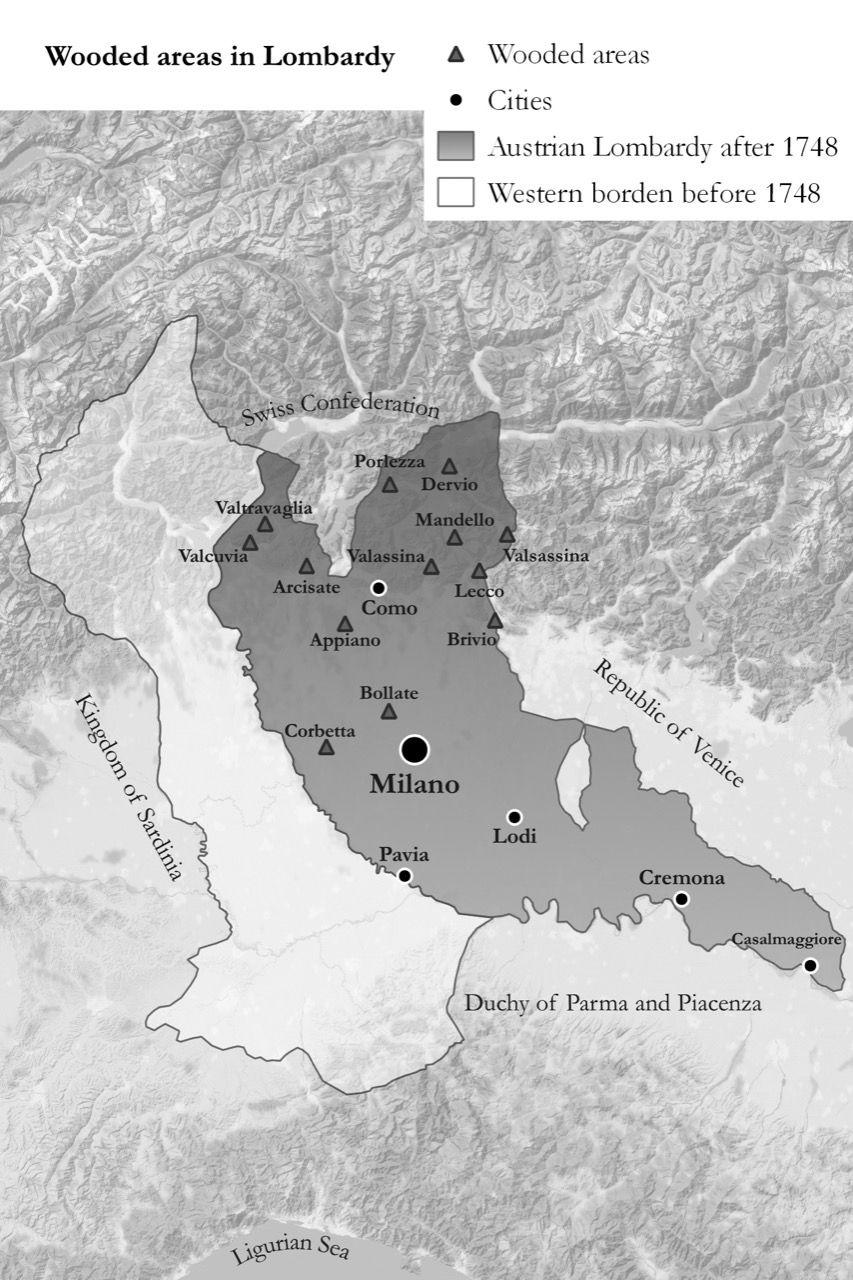
This work concerns the mountainous area of Austrian Lombardy, a state in northern Italy, with Milan as its capital, located between the Kingdom of Sardinia, the Swiss Confederation, the Republic of Venice and the Duchy of Parma and Piacenza. The northern part of the country is part of the Alpine chain and is covered by woods and pasture. The economy of this mountain area during the early modern age was characterized by various activities: the grazing of sheep and cattle, with winter transhumance towards more level areas; the cutting of forests and the sale of timber; the extraction and manufacturing of iron and other proto-industrial activities; the seasonal emigration of labourers to the cities. In these territories, 70% of landed property was made up of common property administered by the heads of households of the communities. During the 18th century, the forest commons were at the centre of discussions relating to the introduction of new management systems aimed at increasing the productivity of timber –something that was strongly felt to be an important requirement in all the European states that used wood as their main fuel (Dowling & Keyser, 2020). This work examines the various points of view that developed at the court of Vienna and amongst Lombard officials, the investigations carried out and the reforms implemented, and the role of the communities.
Given that forests were an essential resource for human survival, the early modern age has been defined as the “Wooden Age”. Wood was the main fuel used for manufacturing and for domestic purposes, and was also essential for the navy and for building houses, roads, bridges, means of transport, fences and military structures (Radkau, 2012; Graham, 2009). In studies on the forests of the early modern age, the prevailing interest has focused on forests destined for the construction of the state navy. The availability of trees to build ships was vital for both trade and warfare. The ability to establish an exclusive supply of trees of suitable quality for shipbuilding has been seen as a factor strongly correlated to the growth of state power (Wing, 2015; Graham, 2002; Wooley, 2020; Occhi, 2006; Lazzarini, 2009, 2021; Appuhn, 2010). However, the navy absorbed only 1% of the timber consumed (Warde, 2006). This work concerns government interventions relating to forests intended for uses other than the navy: these interventions came later and were connected to the significant increases in the price and consumption of wood that occurred in the 18th century.
In early modern Europe, forests were subject to increasing exploitation in relation to proto-industrial activities and the wood trade with cities. In the 18th century, governments intervened with measures aimed at both the privatization and conservation of the forests and these led to the almost total disappearance of forest management by the assemblies of the heads of households (Bonan & Lorenzini, 2021; Agnoletti, 2018; Lazzarini, 2009; Alfani & Rao, 2011; Vecchio, 2010; De Moor, Shaw-Taylor & Warde, 2002; Demélas & Vivier, 2003; Sebastián & Uriarte, 2003; Grab, 1989); only a few areas that benefited from strong legal protection escaped this logic1.
This essay examines problems, discussions, beliefs, objectives and interventions developed by enlightened Lombard officials and by the Viennese court in order to reorganize forest management. The current condition of the sources makes it impossible for this region to have quantitative data on the production and consumption of timber. Neither is it possible to give an ecological picture of the most widespread arboreal species to investigate their changes, themes that have been investigated by some environmental history studies (Graham, 2009; Radkau, 2012; Warde, 2018). The documentation conserved in the Milanese archives is mainly of an administrative nature and is interesting from other points of view. Seventy percent of the forests belonged to the communities, and it was this form of ownership that was the object of the Viennese authorities’ interventions.
The interests of the actors in the field were different and often conflicting. The state authorities did not have a unified vision, with the prince of Kaunitz and the Vienna court intending to apply physiocratic doctrines and privatize all municipally owned forests. Cesare Beccaria and the enlightened Milanese officials only partially shared this conviction and concerned themselves with the more general problem of the well-being of mountain communities with investigations inspired by the cameralist school. In the opposite camp were the iron entrepreneurs, the timber consumers: while some wanted to continue to take advantage of the use of cheap municipal wood, others tried to renew iron smelting methods with government support. Finally, there were the forest-owning communities, which the government regarded as passive subjects, linked to backward traditions, to a multiple use of the forest typical of a natural economy belonging to a semi-feudal past. The government’s objective was to make the production of Lombard timber competitive on the market.
In the dialectic between Milan and Vienna, the Lombard officials had no truck with simplistic solutions, stating that the problems of the mountain economy had to be understood in terms of an examination of the Alpine environment as a whole: the introduction of new ways of using the forests could not work without an evaluation of the other environmental variables. They tackled the problem of forest management with great lucidity, conducting surveys into environmental equilibrium in the mountains and putting forward proposals inspired by the environmental sustainability of the policies implemented. The concept of sustainability –something that appeared in the German sphere in this period (Warde, 2018)– was never explicitly formulated. However, the issues addressed by the Lombard officials proposed fundamental elements related to this, based on the consideration of mountain environments as an aggregate of highly interdependent phenomena. The reforms had to be implemented with awareness and respect for the mountain area’s fragile equilibrium.
This essay consists of an introduction, four chapters and some final conclusions. The second chapter draws a historical picture of the area covered by this paper and describes the traditional uses in forest commons management. The third chapter deals with the effects produced on common forests by reforms such as the introduction of the land registry and the reform of community administration. The fourth chapter outlines the dominant theories in the eighteenth-century regarding the forest management and describes the first specific measures of the Austrian government aimed at improving timber production. The fith chapter is devoted to the debate sparked by the Viennese court’s desire to sell off all common forests, in application of physiocratic doctrines. In the conclusion, the views of the Milanese officials are related to Enlightenment thought and to the recent historiography on woodlands.
2. State, entrepreneurs and communities at the beginning of the 18th century
It is estimated that the Lombard territory under Austrian rule in 1770 measured around 8,000 square kilometers, with a population of 1,100,000 inhabitants, about 19% of whom lived in cities (Bellettini, 1987), who required constant fuel supplies for domestic use and for manufacturing. Outside the cities there was a growing demand for wood for the work of the mines and silk spinning mills, and for other factories and trades that required wood and charcoal. According to a survey of 1781, in the whole state there were 875,273.14 pertiche of forest (equal to 572.881 km2)2, or about 7% of the total cultivatable land, a lower percentage than the central European average (Warde, 2006). The province with the richest expanses of forest was Como, with 353,599.23 pertiche (231.437 km2), just over half of the whole province, (which measured 654,284.2 pertiche, or 428.240 km2). Other districts in the province of Milan that were rich in forestland suitable for supplying the capital were located near Lake Como: Riviera di Lecco, Riviera di Mandello, the parish of Dervio, the Alto Lario, and the parish of Brivio3. We do not, however, know the productive capacity of these forests. Cities in Lombardy also obtained supplies from external markets, but, with the current state of research, the extent of these imports is not known (Bonan, 2022).
FIGURE 1
Wooded areas in Lombardy.
Source: author’s reworking of OpenStreet map with license CCBY SA.
The growth in international demand for timber led to a considerable increase in prices (Malanima 1996, 2006). While these problems were common to other European countries, in Lombardy there was an additional internal factor to contend with. Following the wars of succession in the first half of the century, the forest districts located on Lake Maggiore and in Alto Novarese, from which wood was conveniently transported to Milan, had fallen under the control of the Kingdom of Sardinia. It therefore became essential to try to increase production in other districts within the state and to improve transportation.
In addition to the cities, the forests also had to supply fuel to the factories spread throughout the region. Mining and processing iron for military use, activities developed since the Middle Ages, were large consumers of timber in the mountain areas. The consolidation of the states and the adoption of artillery had focused considerable attention on business activities connected to war. During the period of Spanish rule (1535-1706), the policy adopted by the government to promote this important branch of industry gave entrepreneurs in the sector full freedom to exploit the mines and extensive forest resources. In concrete terms, this meant renouncing the practice of demanding gifts and duties for the transport of iron to the capital and refraining from any central government intervention in the processes of the cutting and exploitation of the forests. Production was organized locally; the cities were only the final destination for sale. Wood harvested in the mining districts was intended to be used in the iron factories. In these areas, the market law of supply and demand did not apply when it came to the purchase of wood: what mattered was personal relationships and the communities’ dependence on the iron manufacturers, who were protected by the government. These businesses not only organized the entire production and commercial system: they also dominated the local administrations and the relations of the mountain communities with the outside world, functioning as intermediaries between the city and the government, to whom they guaranteed a supply of iron. This made the iron manufacturers the de facto arbiters of local material and non-material resources. The forests were owned by the communities, and the systems of use and the cost of wood were determined by the traditional relationship of the local inhabitants’ dependence on the iron entrepreneurs. Furthermore, many villagers were employed in iron production and transportation, and thus their families were directly financially dependent on the iron merchants4. The Spanish government considered the iron sellers to be guarantors of the political stability of this fundamental productive district, as well as suppliers of tools for war that the state lacked5.
Until the mid-18th century the administration of local finances and community assets –including natural resources–, which did not directly affect big politics, continued in the main to concern the residents of the communities themselves, and were managed according to almost immutable traditional practices (Mannori, 2008; Mannori & Sordi, 2001). The government intervened in these matters only in the event of an open conflict and at the request of the local estates. This situation reflected a more general context that was characterized by the central government’s lack of knowledge about the territory. The connections with the territorial districts occurred via the mayors from the countryside, who were represented in the Congregazione dei Contadi and in the Congregazione dello Stato. These congregations’ authority involved the distribution and collection of the tax levy. They were composed of members of the local hegemonic families, who often passed down their seats by inheritance, assuring the Milan government a connection with a distant peripheral administration. There was the possibility of occasional regulatory intervention on the use of forest commons by the central bodies of the Vicario di Provvisione, the Avvocato Fiscale or the Senate, but there were no government officials specifically appointed to enforce these decisions in the territories (Capra, 1987). The inhabitants made use of the forest commons for community and personal needs and periodically sold the cut to earn income that was used to reduce the community’s taxes or debts. The owners of the mines, furnaces and forges were able to ensure the necessary supply of timber for their production by purchasing rights from the communities to harvest timber from their forests for a set, extended time.
These dynamics emerge from the documentation relating to the disputes over the use of the forests that convulsed the most important mining district in the country, Valsassina6. Here, owners of mines and smelting furnaces manipulated the administration of the commons. The Manzonis, the most important family of iron entrepreneurs in Valsassina, offered the most significant example. They controlled all stages of the iron supply chain: they were owners of mines, smelting furnaces and forges, buyers of wood from the forest commons and iron traders with the capital. They had held the position of mayor of the valley for two centuries. This made them arbiters of relations with the capital. Control over relations with the city had enormously strengthened their power. Among the valley dwellers, the Manzonis stood out as defenders of the tax exemptions granted to these mountain territories; they were also guarantors of the grain supplies essential to the mountain population. Their strength derived from the role they had assumed, not only in the production processes, but also as mediators in the relations between the mountain communities and the city with regard to administration, taxation, trade and grain procurement. Monopoly of the various relational levels with the city ensured the Manzonis enjoyed an extensive local hegemony. They came originally from the valley, where they kept numerous people at their service, but also lived in Milan, where they took care of all the matters involving the valley, securing many advantages. In 1646, the Valsassina had been enfeoffed to a Milanese patrician, Giulio Monti. The Manzonis had entered the service of the feudal lord, who resided in Milan, looking after his affairs in the valley. This had given them a predominant position in relation to the local élite of iron entrepreneurs. Costly legal disputes with other entrepreneurs in the Milanese courts, plus frequent recourse to violence, had imposed their hegemony on the valley. The disbursement of numerous loans at interest reinforced the subordination of the villagers and of the numerous figures that the Manzonis employed, such as woodcutters, charcoal burners, miners, smelters, transporters, shepherds, notaries, bravos and others in their service (Dattero, 1997).
The investigations into the management of forest commons conducted by government authorities in the 18th century revealed a well-tested system to the detriment of communities. The Manzonis acquired the right to cut large tracts of municipal woods for 10-13 years. The growth of the trees over this long period was all to the advantage of the buyer. Upon expiry of the contract, as the central office of the Magistrato Camerale wrote,
The forest was not even cut down for a third of its extension and, before the last term expired, the buyer protected himself with the request for a covenant of grace, which seemed like nothing more than an extension of another five or six years to finish cutting; and furthermore in many cases the price of this extension was not fixed, but was left to the discretion of one or more arbitrators, from which a dispute would arise which would be either ignored, or concluded with a disadvantageous transaction7.
The communities’ ability to administer the commons had been greatly weakened and they made scanty earnings from the sales.
3. The Administrative Reforms of the Mid-18th Century and the Secular Balance
Both the growing need for wood and the reforms promoted by the Austrian rulers for fiscal reasons changed this centuries-old balance. In particular, the introduction of the land registry in 1760 and the reform of the communities a few years earlier in 1755 had introduced important innovations. The land registry radically transformed the tax system, depriving the local estates of the power to raise taxes. The monarchy ordered a general measuring of all land and established the amount of tax that each owner had to pay. The land registry was implemented by royal officials and had a uniform value for the whole state.
Although these reforms did not dictate any specific rules for the forests, the fundamental principle of the universal application of the land registry throughout the entire Lombardy region produced considerable indirect effects. The forests of the mountainous areas were previously exempt from taxes; the land registry instead established a moderate tax on them, which provoked many counter appeals. The central government responded by demonstrating that the overall taxes paid by the forest-owning communities were actually lower than in the past, and that there had only been a different distribution of the tax burden8. The real problem related to the new taxes on woodlands therefore did not lie in higher taxes, but rather in the mismanagement that made the forests unprofitable. Unlike in the past, the forests now had to produce greater returns for the communities, which needed reliable income to pay their taxes. The increase in the price of timber should theoretically have provided more assets to the communities; however, as mentioned above, locally consumed timber was exempted from the laws of the market and was monopolized by the iron entrepreneurs9. The result was extremely low prices for timber, the perpetuation of archaic logging practices, and scarce interest in nurturing the health and regeneration of the trees10.
Along with the work on the land registry, a reform of the communities was developed which in 1755 profoundly transformed the traditional administration. The new system was centred on property owners, basing the right to representation on tax payments and no longer on the old corporate membership in the community. The property owners who paid taxes became recognized as directly responsible for the administration of the communities, budgets and communal assets, without any form of exclusivity (Capra, 1987; Mannori, 2008). From that moment on, forest management also began to be based on these assumptions. Another fundamental principle was affirmed alongside this new form of administration: the protective function of the central government with respect to local resources, both financial and natural. To put this principle into action, the community reform of 1755 established the chancellors of the census, royal officials entrusted with local administration. The chancellors were dependent on the central administration of the Magistrato Camerale, from which they had to obtain permission for the stipulation of contracts that involved the communities, and thus also for the sale of harvests from forest commons. The Magistrato Camerale therefore became an active part in decisions related to local administration. The chancellor had to publish government orders and had a more general informative role in relation to local economic and social arrangements. This figure represented something absolutely new in Lombard administration, which until then had had no experience of such a wide-ranging instrument of control in the area. Initially, chancellors were selected from among the members of the communities and were paid by the communities themselves. Then, in 1785, Joseph II decided to place their salary on the government pay-roll, thus reinforcing their dependence on central authority and removing the possibility of any blackmail by local potentates (Capra, 1987). The institution of chancellors of the census was a truly revolutionary measure, breaking as it did the monopoly of local lords such as the Manzonis with regard to relations between the communities and the government.
The new administrative system opened up opportunities for the governing authorities to understand and control the territory in a completely new way. In addition to the extensive processes of regulating the local administrations along lines considered more rational and more effective, the new system also offered the possibility of developing detailed knowledge about the presence of natural resources. This in turn allowed the elaboration of new criteria for the use of these resources to satisfy the growing demand for raw materials, including timber, whose scarcity had become a cause for complaint. The chancellors of the census informed officials in the central magistracies about the current systems of administrating the forest commons, the practices in use for the sale of trees, the community revenues, the methods and schedule with which cutting was carried out, and the presence of livestock. The land registry essentially set in motion fiscal and administrative checks on the uses and on the ecological state of the forests which focused the authorities’ attention on the state’s woodland resources and on the urgency of planning interventions aimed at promoting the protection and sustained growth of the forests. The reforms had given the government the opportunity to extend its control over the territory in new spheres. Government officials noted the existence of large expanses of poorly used forests that were sufficient to provide for all current needs; all that was required was an undertaking to reorganize forestry practices11. The dominant government belief was that the communities that owned the forests were not able to manage their precious resources and that the protective intervention of the prince was therefore necessary. This was not a disinterested intervention: the government would have the opportunity to make vast expanses of previously neglected forest available to energy-devouring manufacturers. In the view of these government officials, the mountain communities owning the forests were only the passive beneficiaries of a process of rationalization of timber production. Important natural resources such as forests became the object of interventions inspired by economic policies and the most accredited scientific studies.
4. Dominant Conceptions of State Officials with regard to Mountain Forests
Since the late 17th century, there had been growing concern in Europe with regard to the depletion of natural resources due to human use, especially in relation to forestry. In the following century the condition of the land and the ability to improve it, man’s power to govern nature, were considered a sign of a state’s civilization (Warde, 2018). New scientific research studied concrete interventions and the central authorities’ greater control over the territory made it possible to implement them.
The policies of enlightened absolutism declared the wish to pursue public happiness, the well-being of the subjects: this was identified with demographic growth, the revival of the economy and good administration of the state –objectives which justified the expansion of sovereign authority over territory (Scott, 1990). Population growth made it increasingly urgent to increase the resources necessary for subsistence and, of these, wood was of primary importance. Furthermore, limited energy availability meant limited possibilities in terms of expanding the manufacturing productions that required fuel. To favour economic development, therefore, it was necessary to free the land from all the traditional constraints which until then had discouraged productive investments. These constraints included municipal properties, which were considered to be vestiges of a feudal past.
Two opposing conceptions existed in the Austrian government in those years with regard to forests: one inspired by German cameralism, the other by physiocratic ideas (Richter, 2015). Cameralism was an economic doctrine designed to promote the strengthening of the state through a cautious policy of protectionism and the planning of best practices aimed at fostering the country’s demographic and productive growth. Forestry policy was subordinated to these objectives; it was necessary for the state to support improvements in forest cultivation, in order to be able to make abundant cheap fuel available to manufacturers (Justi, 1758; Sonnenfels, 1777). Different beliefs matured at court, especially through the initiative of the Prince of Kaunitz, who was inspired by physiocratic ideas and in charge of matters relating to Lombardy. These were dealt with in the Department of Italy, where Luigi Lambertenghi, another convinced physiocrat, held great sway as an expert on Lombard affairs. Kaunitz wished to promote a generalized privatization of all the forests. This, in his opinion, would lead to an increase in the availability of wood, since private owners would know how to cultivate their own interests much more effectively than the communities and would aim to produce more timber12. The proposed solution looked to the English model of enclosures. Some authors of the time, such as Giambattista Giovio and Giambattista Vasco, attacked these liberal beliefs in the conviction that the methods of modern intensive agriculture, which were effective for multiplying the yields of lowland crops, were not suitable for forest cultivation: the long time spans necessary for new growth after cutting down tall trees made them uneconomical for the owners, who would therefore be induced to uproot them (Vecchio, 1974). Both these perspectives regarded municipal ownership of the forests as a relic of the past: forests had to become privately owned or state owned and could no longer be left to immobilist, backward-looking community management.
The first measures decided on by the court were aimed at privatisation. The sale was initially limited to community owned forests on the plain, but the Prince of Kaunitz later pressed for a general sell-off of community lands13. The Tribunale di Provvisione expressed its agreement, but proposed to stretch the sales out over a long period in order to prevent triggering a steep drop in market prices due to excess supply14.
The administration of the forests at the Milanese central level depended on the second department of the Magistrato Camerale, which was managed by Cesare Beccaria15. Beccaria’s first public position had involved teaching Cameral Sciences in Milan, but he was also influenced by the liberal ideas that were widely shared by the followers of the Lombard Enlightenment. He took an intermediate position that considered the more comprehensive ecological balances of the mountains: he was in favour of a partial sale of the forests, which would preserve the collective uses deemed indispensable for the domestic economy of the mountain communities.
The Magistrato Camerale estimated that around 20,000 people lived in the mountain areas, and it was feared that losing the availability of the civic use of the forests could cause the less well-off to emigrate from the state, resulting in serious depopulation in the mountains (Grab, 1989; Romano, 2011)16. However, they also considered that many mountain communities possessed forestland that greatly exceeded the needs of the inhabitants, meaning they could sell17.
Information from the community chancellors poured in to the Magistrato Camerale and, based on this, motions of resolution were drawn up to be presented to the Plenipotentiary, the Count of Firmian. The latter sent these on to the Department of Italy at the court of Vienna, from which executive orders came back by the same route. In the ensuing discussions at the time, Cesare Beccaria consistently asserted with conviction that an edict on the forests should not be too prescriptive. As an expert jurist, he observed that such a law “would suffer the fate of many others, which have fallen into disuse and oblivion for having been too detailed and binding, to the serious detriment of public authority, and having only given rise to many useless complaints” (Beccaria, 1987: 657). The Prince of Kaunitz, minister of Maria Theresa, was of the same opinion.
The Magistrato Camerale assigned the community chancellors extensive responsibilities of control: they had to maintain a precise account of the size and age of the community forests whose harvests were to be sold, and to ensure that only small lots were sold, to be cut from mature forests within a short period of time. This would make it possible to guarantee greater economic benefits to the owner communities and better forest regrowth. According to the rules of agronomy, “the sooner an already mature and cleared forest is cut, the sooner new vegetation follows”. Selling in small batches with the obligation to cut the wood within a year would also favour greater competition among the buyers. As has been noted, in many communities the buyers were always the same, and the woods were secured “at a very low price and with terms for harvesting of up to 20 years”. These good practices would also make it possible to prevent river flooding caused by soil run-off during rains18. These provisions met with the opposition of the iron entrepreneurs, who wanted to procure supplies of cheap wood to the detriment of the communities.
The dominant idea was that the application of new methods of cutting and cultivating forests would produce a more abundant product that would also be useful for supplying the cities. The improvement of communication routes through building canals would shorten distances and favour urban supply. With this in mind, building began on the Naviglio di Paderno, a large hydraulic endeavour that would make the Adda River navigable, thus making transport between Milan, Como and foreign countries less expensive (Bobbi, 2006). However, the effectiveness of the overall theoretical construction had to be measured against the customs of the valley inhabitants, who considered themselves the true custodians of these resources, of the knowledge regarding them and of the practices pertaining to their use –a subject that is certainly open to debate. However, they had perpetuated a system of multiple uses of the forest that integrated the sale of timber with family consumption, livestock and pasture, and this system was destined to disappear in the face of use for purely economic purposes.
A vast conflict involving many opposing interests arose around the forest reorganization that was taking place. The authorities often targeted the customs of the villagers, who were considered less circumspect with regard to promoting a more rapid regeneration of the forest. In reality, however, the iron businesses were especially responsible for the mismanagement and poor reproduction of the forests. It has been calculated that, due to old-fashioned technology, the consumption of wood in an 18th-century blast furnace was equivalent to that of two small towns (Radkau, 2012). The dominance of the iron entrepreneurs over communities, the absence of any external control on the regularity of the contracts and the importance of their production for state interests, meant that they had been able to take advantage of the community forests for decades at negligible costs; neither had they been overly concerned with regard to forest reproduction. Mine and furnace owners had the arguments, and the means to present them, that addressed the concerns of economists who wanted to promote local iron production and limit imports. Meanwhile, the valley dwellers who defended the civic use of the forests had little chance of making their voices heard and asserting their own cause. Furthermore, their demands lacked unity: many villagers worked for the iron businesses as woodcutters, or in reduction to charcoal, iron excavation and smelting, and transportation. At the same time, the business owners opposed a liberalization of sales, since including new competitors in the auctions would cause timber prices to rise. The opposing appeals that reached the Magistrato Camerale were also often by-products of local feuds, which made it very difficult to understand the reality of the facts or to seek mediation useful to bringing about interventions19.
5. Guidelines, Surveys and Initiatives by Enlightened Officials
At the end of the 1770s Kaunitz’s liberal line seemed to prevail: Maria Theresa issued orders to sell all the forest commons (Grab, 1989). However, those orders were not completely carried out for a long time; the sale was implemented for the public woodlands in the communities on the plains, but the project aroused a great deal of concern with regard to the mountains. There seemed to emerge, from various quarters, the idea of the mountain environment as a fragile equilibrium, which required a comprehensive consideration of variables that went beyond mere economic interests. The Milanese officials who collaborated with the government came from the Enlightenment experience of the Accademia dei Pugni and the editorial staff of Il Caffè: they were inspired by the idea that a rational analysis of problems would make it possible to find the best solutions to promote public happiness (Capra, 2017; Francioni & Romagnoli, 1993; Scott, 1990). Things were proceeding in the same way in other European countries in this period, since it was beginning to be observed that reducing the size of forests could bring about calamitous phenomena, such as arid land or flooding. Technical and rational solutions were being sought (Warde, 2018). Their interventions were preceded by an extensive fact-finding survey. This survey, conducted across the territory, allowed them to grasp the extent to which the mountain forests were one part of a more complex ecological system. It involved local administration and finances, manufacturing, emigration and soil conservation: all phenomena that were subject to laws other than those market laws that were too often seen as a panacea for all problems. An awareness began to develop that a greater availability of fuel required experimentation with new balances between humans and natural resources. This meant that the discussions and interventions had to move on a number of different levels: taxation, administration, iron-manufacturing techniques, studies on the vegetation aspects of the forests, community balances and traditional practices, and modern economic doctrines. Establishing a dialectical interaction with the local communities was also considered important: the officials were aware that any legislation that was not agreed upon by the villagers would provoke opposing reactions or be disregarded. Opinions varied. Unlike Cesare Beccaria, Alfonso Longo declared himself in favour of the sale of all forest commons to private individuals. However, he also expressed the need to draft a general registry of all the state forests in order to provide reliable data as a base upon which the best policies could be elaborated –a need already highlighted by Gaetano Rogendorff. The latter specified that the forest registry should indicate the species of the existing trees and cross-reference them to the state’s supply deficiencies, in order to facilitate planning for the cultivation of those species that were most required20.
Questionnaires were sent to the community chancellors requesting information about the size of the forests, their condition, the type of wood they produced and the intervals between successive cuts of the forest. Economic information was gathered, such as the price at which the wood was sold, whether the sale of the forests to private owners was useful and what portion should be reserved for the community, and the costs of transportation. The questionnaires also asked about abuses, ways to improve the cultivation of the forests, the condition of forests that had been private, and if there were uncultivated lands that could be converted to forest21. After examining the responses from the chancellors, two officials, Alberto Besozzi and Ermenegildo Pini, experts in forestry and minerology, were sent to the mountain communities to study the best ways of reorganizing this productive sector. The two visitors had the task of separating the forests to be reserved for common use by the inhabitants from those intended for the sale of wood, and from those intended for permanent sale to private owners. This operation was carried out in consultation with the representatives of the owners from each community. The resolution that was adopted specified that the forests that remained property of the communities had to be divided into small lots, with annual sales of the harvests according to well-defined criteria, under the control of the chancellor of the census and the Consiglio di Governo (the body that took over from the Magistrato Camerale). The other forest commons, excluded from community harvest, were reserved for the periodic sale of wood and were divided into portions to be cut separately. Strict rules were also applied to these: the forest had to be cleared of wood quickly after cutting; residents could use the scraps from the harvest; cows and sheep could only enter the area after a period of eight years, and only with the written permission of the community deputies duly exhibited in the public square. Goats were excluded. Besozzi and Pini’s mandate combined the question of forests with that of mines: during the same visit, they checked on the state of the mines and the iron factories with the purpose of proposing ways to encourage the development of this branch of industry, which was going through a difficult phase22.
Based on the first measures that were decided in situ, an edict was issued for the whole of Lombardy on 5 September, 1784. In addition to the above, it established the intervals of time necessary for forest regrowth relative to the type of trees involved: 50-60 years for larches, 25-30 years for beeches, 10 years for coppice. Furnace and forge owners had priority in the purchase of wood. They were also given the opportunity to circumvent the laws of the market with the right of first refusal on the purchase of the forests with the offer of an increase equal to 1/6 of the base price of the auction. The entire functioning of the new system was entrusted to the community deputies alongside the chancellors of the census23.
The vast survey conducted by Ermenegildo Pini and Alberto Besozzi made a significant amount of statistical data available to the government, and this constituted an important knowledge base for further interventions. Throughout the state they counted 875,273.14 pertiche of forest (equal to 572.881 km2), of which 344,431.10 (225.436 km2) belonged to the communities, 109,212.4 (71.481 km2) were ecclesiastical property and 421,630 (275.964 km2) were privately owned. Uncultivated lands numbered 171,194.6 pertiche, with 125,300.12 pertiche belonging to the communities, 3,729.3 to private owners and 12,164.16 pertiche being ecclesiastical property. These uncultivated lands were mainly concentrated in Vallassina, Valtravaglia, Corte di Casale and Appiano, and the government set out to verify if any of that land was suitable for planting forest. In the Milanese province, one seventh of the land was woodland; of this 4/8, that is half, was privately owned, with the remaining half being 3/8 communal and 1/8 ecclesiastical.
The Magistrato Camerale produced a statistical comparison between the size of the forests and the resident populations, expressing the relationship between forests and inhabitants for each district in mathematical terms. This was useful to create a graphic summary, in the form of a topographic table of the state forests24. Plenipotentiary Wilczek subsequently ordered an investigation into emigration, which was carried out between February and May 178925. Giuseppe Pellegrini, the Intendente Politico Provinciale of Como, asserted that emigration from the mountains was not damaging to the state, since it was not a definitive exodus; people kept their homes open and periodically returned to their valleys. The important thing was to avoid having them definitively establish residence elsewhere26.
The Prince of Kaunitz and the Court continued to favour the sale of all the forests not strictly necessary for the civic uses of the communities and would soon issue a new resolution to that effect27. The Milan Consiglio di Governo, on the other hand, wanting to proceed gradually, tried to buy time. The main argument it adopted was that the communal properties of the plains, the moors, and mortmain assets, had already been put up for sale. Putting an even larger supply of land on the market would cause prices to fall and serious economic damage to the proprietary communities: for the moment, therefore, the Consiglio thought it best to continue to sell the cut of mature woods28.
Political-administrative initiatives merged with scientific ones in those years. Abbot Ermenegildo Pini compared traditional logging practices with the results of the studies offered by modern agronomic science, work that involved the Società Patriottica di Brera. The Società embodied Enlightenment faith in reason, science and the effectiveness of remedies developed through rational methods. The Consiglio di Governo, led by Plenipotentiary Wilczeck, opened consultations with the Società on the best ways to promote healthy forest growth. The collaboration began in earnest in the 1780s, especially while the Società was led by Abbot Carlo Amoretti. He was extremely sensitive to these problems and intensified the relations of the Società with the administrative level of the government. Ermenegildo Pini and Alfonso Castiglioni presented the results of the vast exploratory work carried out in the forests of Lombardy to discuss hypotheses with experts and scientists regarding remedies to be adopted. A competition dedicated to proposals for the most suitable ways to promote forest regeneration was also launched29. The government also undertook the renewal of the iron factories. Improvements were encouraged with cash prizes. The conversion of three smelting furnaces to Norwegian use was financed, which made it possible to halve the consumption of charcoal. However, wood continued to be the only fuel used30.
Finally, wood transportation practices were considered responsible for soil washing away. The floating of wood caused the formation of channels that promoted soil washout. In the terms of sale for cutting the forests, it was therefore required to “also specify the place in which it was lawful for the buyer to run the wood, with a strict prohibition on arbitrating another one”31. Ermenegildo Pini proposed the appointment of hydraulic engineers to send to the mountain communities. However, this involved high costs, and the proposal was rejected by the Camera dei Conti, which instead meant to give these tasks to the chancellors of the census32.
6. Conclusion
Recent historiography has considered forest management reforms in the modern age as a manifestation of the will of sovereign absolutism to control forests. The increase in demand for timber gave rise to alarming reports regarding the exhaustion of this important resource. It was demanded that a remedy be found. Recent studies have argued that there was, in reality, no global emergency and that the scarcity and depletion of wood was a danger conjured up in order to justify the goal of extending government control over this important resource. Large forest reserves existed in various places around the earth and resorting to importation was always possible (Warde, 2006; Radkau, 2012; Woolley, 2020). If this was certainly true where quality timber was concerned, and especially timber used for the navy, it was a different matter with timber intended for manufacturing and domestic uses. For this low-quality timber, imports were uneconomical and in the 18th century many governments tried to provide an answer by focusing on increasing domestic production (Kander, Malanima & Warde, 2013). In Lombardy, too, imports remained limited, becoming common on a larger scale only in the 19th century (Bonan, 2022).
At that time, therefore, people had to deal with the need to increase production without destroying the forests. The 18th-century rationalistic mentality, here as in other fields, forcefully declaimed the will to abandon “traditional” management in order to move on to a management that was “scientific” and rational. The intention was, in other words, to promote intensive cultivation, which would reduce pastures and the multiple uses of forests, in order to definitively leave behind traditional cultivation based on the natural capacity of forests to regenerate after cutting (Szabo, 2020). How to implement these innovations aroused heated debates, inspired by the two dominant economic theories in Europe: physiocracy, which favoured sales to private individuals and the affirmation of agricultural individualism on the model of English enclosures; and Germanic cameralism, which inclined towards greater state dirigisme in order to maintain the sovereign’s tutelage over the economy.
The opposition between privatisation, state intervention and traditional community management has been extensively examined by the historiography, starting with Hardin’s strongly critical positions on collective property (1968). These have been vigorously contested by Hamish Graham (2002), Elinor Ostrom (2015), and Christopher Woolley (2020). The latter have observed, however, that the various policies implemented by government authorities aimed to impose private or state control over the forests, leading in both cases to the abolition of the shared management of the local communities.
It is no easy matter, in the events in Lombardy under examination, to think of solutions inspired either by good community management (Ostrom, 2015) or by the “virtuous” intervention of the free market (Hardin, 1968).These practices had coexisted in traditional forest management, leading to a predatory use of the commons by iron entrepreneurs and wood merchants –something that responded neither to the interests of the communities owning the forests, nor to production growth, and least of all to ideas of conservation.
The reforms implemented in the second half of the 18th century were oriented both towards privatization and the assertion of greater state control: however, unprecedented sensitivity also emerged with regard to the problem of the ecological balance of communities. In the lowland woods, the physiocratic campaign in favour of generalized privatizing had the effect of cancelling municipal properties. The transposition of the same policy to the mountains, on the other hand, was at the centre of a negotiation between the Viennese court and the enlightened officials. The court proposed unitary solutions for the whole country that would have simplified the government of the territory, wanting as it did to cede to private individuals a resource whose management was very costly in terms of political and material energies. The objective was to economize, a move in the opposite direction with respect to a hypothetical absolutist will to assert greater state control over the forests. The court was not interested in exercising direct control over the resources of mountain communities whose political and social dynamics were not centrally controlled. It was preferred to cede the forests to private individuals, in the hope of being able to obtain an increase in productivity within a legal framework.
Lombard officials were of a different mind. They developed new tools for understanding the territory, and, on the basis of statistical surveys conducted in the area involved, expressed serious concern about the environmental sustainability of the policies put forward by the court. The enlightened Milanese officials raised questions relating to the preservation of the complex ecological balances that existed in the communities. The concepts of environment and sustainability were not formulated explicitly and these definitions, employed only in more recent times, do not appear in their accounts. However, the instruments of analysis and the proposals expressed show an approach to the problems that clearly takes sustainability into account (on this concept, see Warde, 2018).
The 18th century officials were the most genuine interpreters of absolutist government, of the idea of the sovereign as guardian of the public interest, and they were foreign to the forms of bargaining typical of the traditional corporate state. They were not, however, merely passive executors: they alone were able to know, administer and control the Lombard territory within the framework of modern institutions (Capra, 1987). Their voice could not be ignored. The court’s ideas seemed to stand in stark contradiction to the objectives regarding the population and economic growth of the mountain areas. The spectre of mountain depopulation, raised on the basis of the new statistical science produced by 18th century rationality, brought a halt to the court’s privatization projects. It was a complex issue and the interventions promoted by intellectuals and academics installed in government positions were certainly not decisive. The development of forestry reforms was concentrated in the 1770s and 1790s. The second half of the 18th century had been a period of prolonged peace for Lombardy, and this had greatly favoured the enlightened policies inspired by the promotion of “public happiness”. From the 1790s, on the other hand, with the start of the Napoleonic wars, there was a resumption of international hostilities and investigations into forest conditions receded into the background. In the following century, however, the conclusions reached by Cesare Beccaria and the Milanese officials continued to influence government policies regarding mountain areas. During the Restoration, the declared objective became a “scientific” management of the woods, aimed at increasing production and the abandonment of traditional practices (Dowling & Keyser, 2020).
However, 19th-century sources show that traditional uses of the forest in the Lombard valleys persisted for a long time. In Lombardy-Veneto, a decree was discussed to prohibit grazing in the woods –a sign that grazing was still widespread. In fact, it was observed that in the Alps it was common practice in autumn and spring for “the animals [to be] taken out of the stables and sent to the mountains to graze freely in the municipal and private woods, where the vegetation is more precocious”33. From the decree letter, it is clear that these practices involved municipal forests and private forests without distinction: even privatization, therefore, had not led to the more scientific and productive forest management that had been hoped for.
As far as mountainous areas were concerned, however, it was stated that it was not appropriate to prohibit these grazing practices, given that “should they be deprived of them”, valley dwellers “would, rather than temporary migrations, be forced to follow a course of absolute expatriation with their families”. In the mountain forests, therefore, it was decided only to send inspectors to regulate the common grazing rights34.
If, therefore, the practical short-term effectiveness of the reforms promoted in the 18th century was modest, statistical surveys and the reflections of enlightened officials still had a lasting influence. The unified consideration of the fragile balance of the mountain environment, and of the various factors that make up its composition, became an important variable that had to be taken into account.
ACKNOWLEDGEMENTS
The author would like to thank the Historia Agraria editorial board and the anonymous reviewers for their suggestions, questions and comments, which have helped to improve this work. The author would also like to thank the members of the Bo.S.Co research group, Paola Andreani, Giacomo Demarchi, Paolo Grillo, Blythe Alice Raviola, Ilda Vagge, for their collaboration and discussions during the covid pandemic.
Archival sources
Archivio di Stato di Milano, Agricoltura parte antica, 4,5
Archivio di Stato di Milano, Agricoltura parte moderna, 6
Archivio di Stato di Milano, Censo parte antica, 2154, 2155, 2156, 2157
Archivio di Stato di Milano, Commercio parte antica, 205
Archivio di Stato di Milano, Popolazione parte antica, 1
REFERENCES
Agnoletti, Mauro (2018). Storia del bosco: Il paesaggio forestale italiano. Roma: Laterza.
Alfani, Guido & Rao, Riccardo (Eds.) (2011). La gestione delle risorse collettive: Italia settentrionale secoli xiii-xviii. Milano: Franco Angeli.
Appuhn, Karl (2010). A Forest on the Sea: Environmental Expertise in Renaissance Venice. Baltimore: Johns Hopkins University Press.
Beccaria, Cesare (1987). Atti di governo: Serie I 1771-1777, in Firpo, Luigi (ed.), Edizione nazionale delle opere di Cesare Beccaria, vol.VI, Milano: Mediobanca.
Bellettini, Athos (1987). La popolazione italiana: Un profilo storico. Torino: Einaudi.
Bobbi, Silvia (2006). La Milano dei Fé: Appalti e opere pubbliche nel Settecento. Soveria Mannelli: Rubbettino.
Bonan, Giacomo (2022). Pionieri nella frontiera del legname?: I commercianti di legname in Italia settentrionale durante l’industrializzazione. Imprese e Storia, (46), 63-91.
Bonan, Giacomo & Lorenzini, Claudio (2021). Common Forest, Private Timber: Managing the Commons in the Italian Alps. The Journal of Interdisciplinary History, (52), 1-26.
Canetta, Rosalba (1980). Una fonte per lo studio della mobilità della popolazione nel Settecento: L’inchiesta del 1789 sull’emigrazione nella Lombardia Austriaca. In La popolazione italiana del Settecento (pp. 501-10). Bologna: Clueb.
Capra, Carlo (1987). La Lombardia austriaca nell’età delle riforme 1706-1796. Torino: Utet.
Capra, Carlo (1996). Kaunitz and Austrian Lombardy. In Grete Klingenstein & Franz A. J. Szabo (Eds.), Staatskanzler Wenzel von Kaunitz-Rietberg, 1711-1794: Neue Perspektiven zu Politik und Kultur der Europäischen Aufklärung (pp. 245-60). Graz: Andreas Schnieder.
Capra, Carlo (2017). La felicità per tutti: Figure e temi dell’Illuminismo lombardo. Milano: Aracne.
Corona, Gabriella (2010). The Decline of the Commons and the Environmental Balance. In Marco Armiero & Markus Hall (Eds.), Nature and History in Modern Italy (pp. 89-107). Athens: Ohio University Press.
Dattero, Alessandra (1997). La famiglia Manzoni e la Valsassina: Politica, economia e società nello Stato di Milano durante l’Antico Regime. Milano: Franco Angeli.
Dattero, Alessandra (Ed.) (2022). Il bosco: Biodiversità, diritti e culture dal medioevo al nostro tempo. Roma: Viella.
Demélas, Marie-Danielle & Vivier, Nadine (2003). Les propriétés collectives face aux attaques libérales (1750-1914), en Europe occidentale et en Amérique Latine. Rennes: Presses Universitaires de Rennes.
De Moor, Martina, Shaw-Taylor, Leigh & Warde, Paul (Eds.) (2002). The Management of Common Land in North West Europe: c. 1500-1850. Brepols: Turnhout.
Dizionario biografico degli Italiani (1960-2022). Roma: Istituto della Enciclopedia Italiana.
Dowling, Abigail Paige & Keyser, Richard (Eds.) (2020). Conservation Roots: Managing for Sustainability in Preindustrial Europe, 1100-1800. New York/Oxford: Berghahn.
Francioni, Gianni & Romagnoli, Sergio (Eds.) (1993). “Il Caffè”: 1764-1766. Torino: Bollati Borighieri.
Frumento, Armando (1963). Imprese lombarde nella storia della siderurgia italiana II: Il ferro milanese tra il 1450 e il 1796. Milano: Allegretti.
Grab, Alexander (1989). Enlightened Absolutism and Commonlands Enclosure: The Case of Austrian Lombardy. Agricultural History, 63 (1), 49-72.
Graham, Hamish (2002). Profits and Privileges: Forest and Commercial Interests in Ancien Régime France. French History, 16 (4), 381-401.
Graham, Hamish (2009). Fleurs-de-lis in the Forest: Absolute Monarchy and Attempts at Resource Managment in Eighteenth-Century France. France History, 23 (3), 311-35.
Hardin, Garrett (1968). The Tragedy of the Commons. Science, (162), 1243-48.
Justi, Johann Heinrich Gottlobs von (1758). Staatwirtschaft oder systematische Abhandlung aller Oekonomischen und Cameralwissenschaften, die zu Regierung eines Landes erfordert werden. Leipzig: Breitkopf.
Kander, Astrid, Malanima, Paolo & Warde, Paul (Eds.) (2013). Power to the People: Energy in Europe over the Last Five Centuries. Princeton: Princeton University Press.
Lazzarini, Antonio (2009). Boschi e politiche forestali: Venezia e Veneto tra Sette e Ottocento. Milano: Franco Angeli.
Lazzarini, Antonio (2021). Boschi, legnami, costruzioni navali: L’Arsenale di Venezia fra xvi e xviii secolo. Roma: Viella.
Malanima, Paolo (1996). Energia e crescita nell’Europa preindustriale. Roma: Nis.
Malanima, Paolo (2006). Energy Consumption in Italy in the 19th and 20th Centuries: A Statistical Outline. Napoli: Cnr.
Mannori, Luca (2008). La nozione di territorio fra antico e nuovo regime: Qualche appunto per uno studio sui modelli tipologici. In Luigi Blanco (Ed.), Organizzazione del potere e territorio: Contributi per una lettura storica della spazialita (pp. 23-44). Milano: Franco Angeli.
Mannori, Luca & Sordi, Bernardo (2001). Storia del diritto amministrativo. Roma/Bari: Laterza.
McNeill, John (1992). The Mountains of the Mediterranean World: An Environment History. Cambridge: Cambridge University Press.
Occhi, Katia (2006). Boschi e mercanti: Traffici di legname tra la contea del Tirolo e la Repubblica di Venezia (secoli xvi-xvii). Bologna: Il Mulino.
Odescalchi, Marco (1941). Relazione sul commercio, le manifatture e l’agricoltura. In Carlo Antonio Vianello (Ed.), Relazioni sull’industria, il commercio e l’agricoltura lombardi del ‘700. Milano: Giuffré.
Ostrom, Elinor (2015). Governing the Commons: The Evolution of Institutions for Collective Action. Cambridge: Cambridge University Press.
Radkau, Joachim (2012). Wood: A History. Cambridge: Polity.
Richter, Susan (2015). Pflug und Steuerruder: Zur Verflechtung von Herrschaft und Landwirtschaft in der Aufklarung. Köln: Böhlau.
Romano, Maurizio (2011). I beni “comunitativi”: La gestione delle risorse collettive nella Lombardia austriaca della seconda metà del Settecento. In Guido Alfani & Riccardo Rao (Eds.), La gestione delle risorse collettive: Italia settentrionale, secoli xiii-xviii (pp. 207-26). Milano: Franco Angeli.
Scott, Hamish M. (Ed.) (1990). Enlightened Absolutism: Reform and Reformers in Later Eighteenth-Century Europe. London: Macmillan.
Sebastián, José Antonio & Uriarte, Rafael (Eds.) (2003). Historia y economía del bosque en la Europa del Sur (siglos xviii-xx). Zaragoza: Prensas Universitarias de Zaragoza.
Sonnenfels, Joseph von (1777). Politische Abhandlungen. Wien: Joseph Edlen von Kurzböck.
Szabo, Péter (2020). Traditional Woodland Management, Forest Legislation, and Modern Nature Conservation in East-Central Europe. In Abigail Paige Dowling & Richard Keyser (Eds.), Conservation Roots: Managing for Sustainability in Preindustrial Europe, 1100-1800 (pp. 304-26). New York/Oxford: Berghahn.
Vecchio, Bruno (1974). Il bosco negli scrittori italiani del Settecento e dell’età napoleónica. Torino: Einaudi.
Vecchio, Bruno (2010). Forests Visions in Early Modern Italy. In Marco Armiero & Marcus Hall (Eds.), Nature and History in Modern Italy (pp. 108-25). Athens: Ohio University Press.
Venturi, Franco (Ed.) (1958). Illuministi italiani III: Riformatori lombardi, piemontesi e toscani. Milano/Napoli: Ricciardi.
Visconti Agnese (2000). Risorse energetiche e amministrazione del territorio nella Lombardia dell’assolutismo asburgico, In Antonielli, Livio, Capra, Carlo, Infelise, Mario (eds.) Per Marino Berengo: Studi degli allievi (pp.605-618). Milano: Franco Angeli.
Warde, Paul (2006). Fear of Wood Shortage and the Reality of the Woodland in Europe, c.1450-1850. History Workshop Journal, 62 (1), 28-57.
Warde, Paul (2018). The Invention of Sustainability: Nature and Destiny, c.1500-1870. Cambridge: Cambridge University Press.
Wing, John (2015). Roots of Empire: State Formation and the Politics of Timber Access in Early Modern Spain, 1556-1759. Leiden: Brill.
Woolley, Christopher (2020). The Forests Cannot be Commons: Spanish Law, Environmental Change, and New Spain’s Council on Forests. The Americas, 77 (1), 41-71.
Zanolin, Giacomo (2020). I parchi naturali tra antichi usi civici e beni comuni: Riflessioni a partire da un caso di studio: Il Parco del Bosco delle Sorti della Partecipanza. Rivista geografica italiana, 127 (2), 51-75.
↩︎ 1. On the western border of Lombardy, the forest of Partecipanza still exists today and is administered by the heads of households ( Zanolin , 2020).
↩︎ 2. Archivio di Stato di Milano (ASM), Agricoltura parte antica 5, drafts of the comparison of the perticato of the woods of each Lombard district, undated, datable to 1781. The pertica (equal to 24 tavole ) was the unit of measurement adopted for the Teresian land registry and was equal to 654.5179 square meters.
↩︎ 3. ASM, Agricoltura parte antica 4, consultation of the Magistrato Camerale to the Count of Firmian, Plenipotentiary of Austrian Lombardy, 30 May 1772. The picture drawn by the government officials was not dramatic: this territory was still endowed with vast forest reserves, which suggested a situation of relative abundance if they were well employed. The quantitative data, however, must be contextualized with transportation and types of use ( Radkau , 2012).
↩︎ 4. These dynamics were common to other Alpine territories (see Occhi , 2006; Bonan & Lorenzini , 2021; Vecchio , 1974, 2010; Lazzarini , 2009).
↩︎ 5. For the dynamics that involved the major Lombard mining districts, refer to ASM, Censo parte antica, 2154, 2155, 2156, 2157.
↩︎ 6. The iron production of this valley in the 18 th century represented 49% of all Lombardy ( Frumento , 1963: 161).
↩︎ 7. ASM, Censo parte antica, 2154, proposal by the Magistrato Camerale for the regulation of the forest commons, 1768.
↩︎ 8. In Valsassina, where common property constituted 73% of the terrain, the overall cameral taxes previously amounted to 33,000 lire annually. With the new rules, they came to 30,805, a saving of 2,195 lire. There was, therefore, no increase, but rather a lowering of the tax burden of around 8%. ASM, Censo parte antica, 2157, consultation of the Magistrato Camerale, 22 May 1774.
↩︎ 9. Regarding the relationships between forests and markets, see especially Radkau (2012).
↩︎ 10. For a comparison with the use of forests around the Italian peninsula, refer to Dattero (2022), Lazzarini (2009, 2021), Agnoletti (2018), Occhi (2006), and Vecchio (1974, 2010).
↩︎ 11. Marco Odescalchi, an official charged in 1773 with carrying out a visit to the Lombardy forests to monitor their status, expressed it in this way: “On the mountains of Comasco, they cut the forests for wood ungoverned by any law, so that these are either destroyed or take many years to recover. A regulation would be indispensable in order to establish the method and time for cutting, in order to assure, in the future at least, the conservation and growth of the forests, given that, due to its scarcity, firewood today has risen to a very high price” ( Odescalchi , 1941: 149).
↩︎ 12. ASM, Agricoltura parte antica 4, post scriptum of the Prince of Kaunitz to the count of Firmian, 19 October 1775. On Kaunitz’s initiative for Lombardy, see Capra (1996).
↩︎ 13. For the function of indirect protection exercised by the community assets on the forest, see Corona (2010), Vecchio (2010). The spread of physiocratic ideas had encouraged the similar selling of forest throughout Europe during the eighteenth century ( Sebastián & Uriarte , 2003; Demélas & Vivier , 2003; De Moor, Leigh Shaw Taylor & Warde , 2002).
↩︎ 14. ASM, Agricoltura parte antica 4, report of the Tribunale di Provvisione to the Magistrato Camerale, 27 February 1776.
↩︎ 15. After the fame achieved during his youth, his trip to Paris and the invitation to Russia, Cesare Beccaria withdrew from public life and worked in the state administration. Like him, the majority of enlightened Lombard officialdom was included in the public administration, contributing to bringing new blood and new ideas to governing the country. The bibliography regarding the group of Lombard Enlightenment thinkers is a vast one. For some biographical data, I refer to the outline by Capra (2017), Venturi (1958) and to the respective various entries in the Dizionario Biografico degli Italiani .
↩︎ 16. Population growth was a fundamental axiom of the cameral sciences, required to promote the development of agriculture, manufacturing and commerce –an essential prerequisite for public happiness and state power ( Justi , 1758; Sonnenfels , 1777).
↩︎ 17. ASM, Agricoltura parte antica 4, draft of Antonio Pellegrini and Gianrinaldo Carli to Archduke Ferdinando, 31 July 1776.
↩︎ 18. ASM, Agricoltura parte antica 4, draft of the edict on forests with the reliefs of the court, undated, datable to 1775.
↩︎ 19. This was especially the case of Valsassina, the major mining district in Lombardy ( Dattero , 1997).
↩︎ 20. ASM, Agricoltura parte antica 4, undated draft by Alfonso Longo, datable to 1776; report of Rogendorff to the Magistrato Camerale, 8 September 1773. Similar experiments with tree planting were carried out in Germany and Switzerland and would be promoted in Venice in the following century with different results ( Radkau , 2012: 106 et seq.; Lazzarini , 2009).
↩︎ 21. ASM, Agricoltura parte antica 4, consultation of the Consiglio di Governo to Plenipotentiary Wilczeck, 8 August 1781.
↩︎ 22. Ibid. , report of Alberto Besozzi and Ermenegildo Pini to the Magistrato Camerale, 29 November 1783.
↩︎ 23. ASM, Agricoltura parte antica 5, printed royal decree of Joseph II, 5 September 1784.
↩︎ 24. Ibid. , drafts of the comparison on the number of pertiche in each district, undated but from the 1780s.
↩︎ 25. ASM, Popolazione parte antica 1. For an examination of this source see Canetta (1980: 501-10); on the ecological risks caused by mountain emigration, see McNeill (1992).
↩︎ 26. ASM, Agricoltura parte antica 5, report of Giuseppe Pellegrini to Wilczeck, 5 March 1789.
↩︎ 27. Ibid. , report of the Consiglio di Governo to Archduke Ferdinando, 12 December 1785.
↩︎ 28. Ibid. , report to Archduke Ferdinando, 7 October 1785.
↩︎ 29. Ibid. , exchange of letters between the Società and the Consiglio di Governo, 20 and 28 June 1790. The Società Patriottica with Pietro Secco Comneno and Carlo Amoretti was also particularly engaged in the research for alternate fuels, such as peat and fossil carbon ( Visconti , 2000).
↩︎ 30. Beccaria, Atti di governo, serie III, 1784-1786, pp. 15, 35-9, 89-90, 228, 558, 795; ASM, Commercio parte antica, 205, undated tables written by Abbot Ermenegildo Pini.
↩︎ 31. ASM, Agricoltura parte antica 5, unsigned draft, 8 July 1789.
↩︎ 32. Ibid. , report of the Camera dei Conti, 6 August 1788; report by Rogendorff to the Consiglio di Governo, 30 August 1788.
↩︎ 33. ASM, Agricoltura parte moderna, 6, discussion of the Milan Royal Forestry Inspectorate regarding the decree on forests, 31 March 1852.
↩︎ 34. Ibid.